

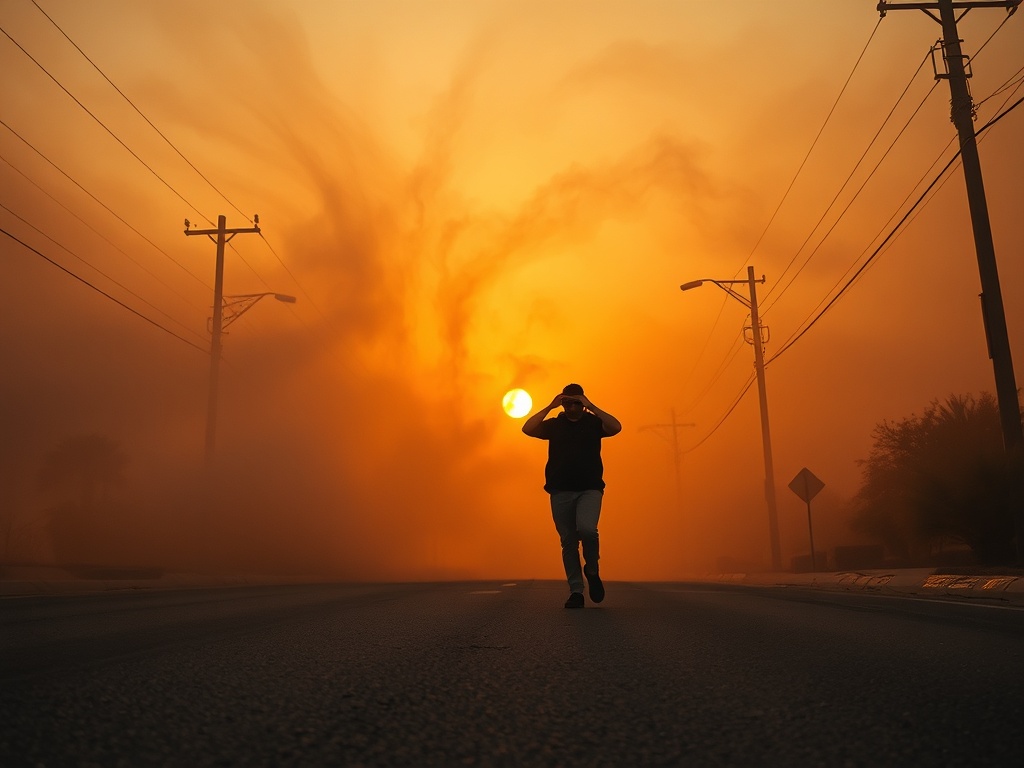

Arizona officials debuted a new five-point dust storm severity scale for the Phoenix metropolitan area as the 2026 monsoon season began. The Phoenix Dust Storm (PHX-DUST) scale categorizes haboobs based on PM10 dust concentration levels measured by local air-quality sensors, providing the first standardized scientific tool to classify dust storms after they occur, researchers said.
The Phoenix Dust Storm (PHX-DUST) scale ranks dust storms from Category 1 to Category 5, with Category 5 representing the most severe events, officials said. The scale is based primarily on measurements of PM10 dust concentrations—particulate matter less than 10 micrometers in diameter—recorded by a network of air-quality sensors across the Phoenix metropolitan area. Normal ambient dust levels in the Phoenix valley rarely exceed 500 µg/m³, the researchers noted.
Category 1 begins at 1,000 micrograms per cubic meter (µg/m³) of PM10, while Category 5 corresponds to concentrations of 5,000 µg/m³ or higher, according to Arizona State University (ASU) researchers involved in the project.
The PHX-DUST scale was developed by ASU climatologist Randy Cerveny and atmospheric scientist Andrew Heintzman, among others, following an analysis of 189 dust storms recorded in Phoenix since 2010. The methodology underpinning the scale was published in the Bulletin of the American Meteorological Society in late 2025, providing a peer-reviewed scientific foundation for its operational use. The scale is designed to be applied after dust storm events, similar to how tornadoes and hurricanes are classified, officials said. Each storm will be assigned a category based on sensor data once the event has fully passed.
In addition to PM10 concentrations, the scale incorporates secondary factors such as wind speed, event duration, and geographic coverage of the dust storm. The system includes subcategories or letter designations that describe aspects like the spatial extent and wind strength of each event, allowing for more detailed characterization. The sensor network feeding the scale consists of at least 22 air-quality monitoring stations throughout the Phoenix area, providing high-resolution spatial data during haboobs, officials said.
Local media outlets, including ABC15 meteorologist Amber Sullins, collaborated with ASU researchers and 13 other organizations to develop and refine the scale ahead of its 2026 debut. Sullins and other Phoenix-area TV meteorologists plan to incorporate PHX-DUST categories into nightly weather segments and monsoon specials to help viewers better understand the severity of dust storms when they occur. An online dashboard is also planned to provide public access to storm categories and detailed subcategory information, according to ASU sources.
The scale aims to provide emergency managers, scientists, and the public with an objective, standardized measure of dust storm severity based on air quality and hazard potential. Heintzman said the system will also enable meteorologists to study broader dust storm patterns, including trends over time and relationships to monsoon dynamics. The scale’s introduction coincides with forecasts for the 2026 monsoon season, which runs from June 15 to September 30 and is expected to bring a 33 to 50 percent chance of above-normal precipitation across much of Arizona, according to the Climate Prediction Center and regional outlooks.
Forecasts also call for warmer-than-average temperatures during the monsoon season, continuing a trend of hot summers that can dry soils and increase dust availability ahead of storm outflows. Local monsoon outlooks suggest that the latter half of the season may produce more intense storms, increasing the likelihood of strong outflow winds and haboobs. Since 2010, Phoenix has experienced a significant number of dust storms, underscoring the importance of having a standardized system to classify and communicate their severity, officials said.


Comments are closed.