

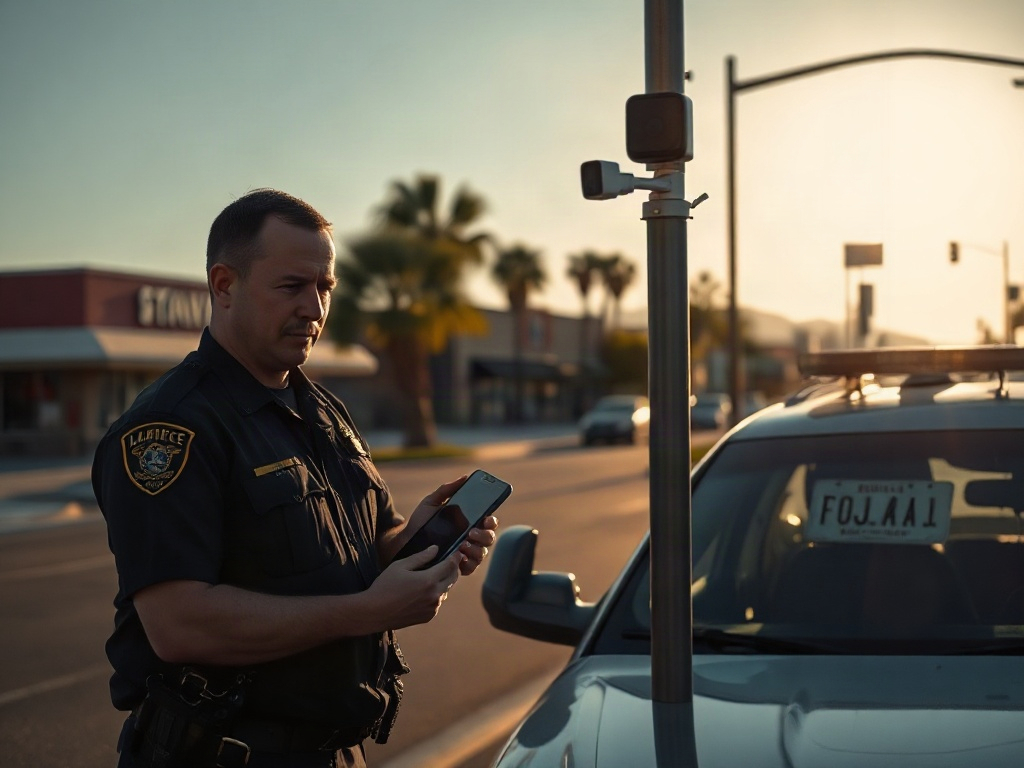

Arizona law enforcement agencies conducted more than 110,000 searches of Flock Safety’s license plate reader database without holding paid contracts, according to an AZCIR analysis. The Phoenix Police Department accounted for more than 100,000 of those searches, accessing the network through a no-cost agreement signed by then-Chief Jeri Williams that never went before the City Council.
The analysis identified at least eight Arizona law enforcement agencies that accessed Flock’s network through no-cost deals or through partnerships with other agencies, according to AZCIR. The Yavapai County Sheriff’s Office, the Maricopa County Attorney’s Office, and the Pinetop-Lakeside Police Department all signed five-year, no-cost memoranda of understanding with Flock, records show.
Pima County ran at least 4,000 searches of Flock cameras without any agreement, according to audit logs.
The Yavapai County Board of Supervisors approved its agreement in 2022 on the consent agenda without public discussion, according to AZCIR. The sheriff’s office has conducted more than 2,000 searches since, with some returning sightings from as far away as Cobb County, Georgia, and West Seneca, New York, records show.
Pinetop-Lakeside, a town of about 4,000, signed its agreement in 2022 after Flock notified police that a private subdivision had installed cameras, according to Police Chief Dan Barnes. Officers ran hundreds of searches between September 2023 and April 2025, records show. Barnes said Flock later ended the agency’s national lookup privileges because it was not a paying customer, citing a new company policy.
Flock approached the Pima County Sheriff’s Office two years ago and offered to install cameras at high-traffic intersections, officials said. The county declined the cameras, but detectives retained database access.
Three smaller departments—Marana, Globe, and Superior—relied on other agencies already using the system to conduct searches over a handful of days, most recently in 2024, according to AZCIR. Police chiefs in Marana and Globe said officers must provide a case number to search, that policies require a legitimate law enforcement purpose, and that audits found no misuse. Superior Police Chief Joaquin Manuel said a detective may have previously partnered with a county to use Flock.
The findings prompted criticism from state lawmakers. Sen. Lauren Kuby, a Democrat representing parts of Maricopa County and greater Phoenix, called the agreements a “massive loophole” that reflects “a breakdown in basic transparency.”
“Any agreement that lets an agency track where people go should require open public debate and a vote by elected leaders—period,” Kuby said.
Sen. Jake Hoffman, a Republican representing parts of Maricopa and Pinal counties, said the Fourth Amendment is not an invitation for the government to find workarounds around warrant requirements.
Chad Marlow, senior policy counsel at the American Civil Liberties Union, said he had never encountered arrangements like these and questioned whether Flock was “giving away people’s data for free,” calling it “extremely troubling.” Dave Maass, head of investigations at the Electronic Frontier Foundation, said law enforcement “can backdoor a whole surveillance network” and that communities need an across-the-board removal of automated license plate reader access.
Flock Safety did not respond to repeated requests for comment. The company has faced growing scrutiny over how agencies use its more than 120,000 cameras after reports of officers misusing the system to track romantic partners and stalk strangers. At least 11 Arizona agencies have canceled their Flock contracts, and Arizona Attorney General Kris Mayes has opened an investigation into the state’s use of license plate readers. Tempe has canceled its contract and become the first city in Arizona to ban the cameras.
AZCIR analyzed roughly four years of Flock audit logs obtained through public records requests and compiled by the website Have I Been Flocked. The records contained extensive duplication, with a single search appearing multiple times or in the logs of each agency whose cameras were involved. Because the website secured records from only a fraction of agencies using Flock, the total number of searches is likely a significant undercount, according to AZCIR.


Comments are closed.