

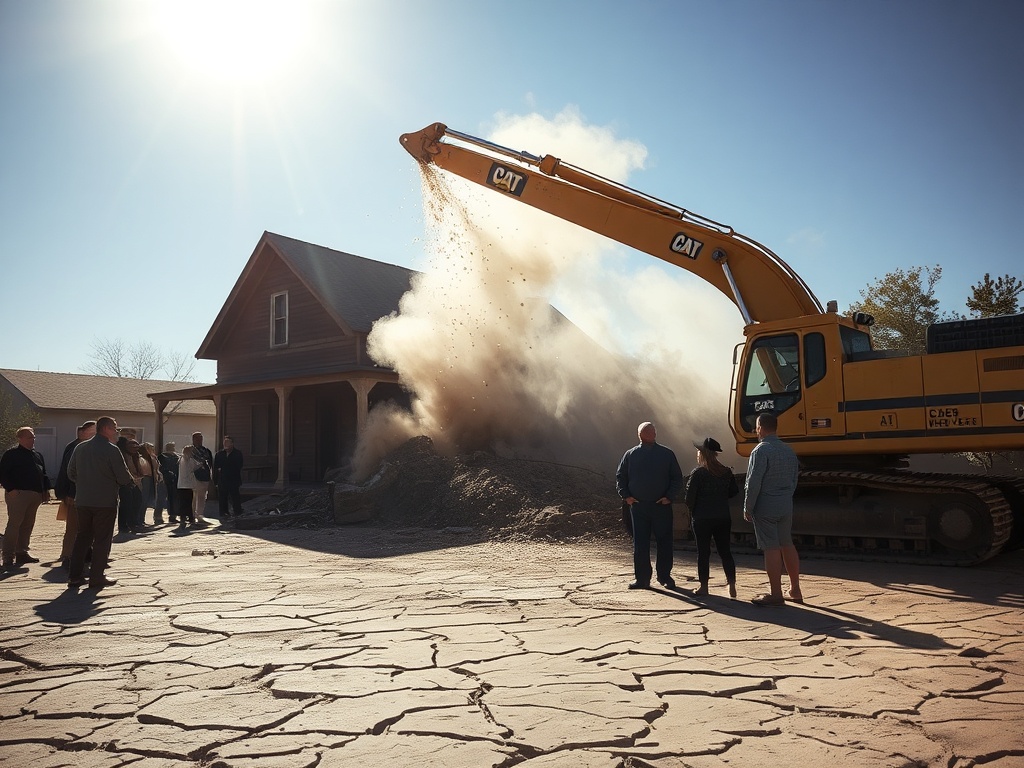

A more than 100-year-old house known as the Anne Lester House at 1177 E Lester Street in Tucson’s Jefferson Park neighborhood was demolished on March 6, 2026. According to neighborhood accounts and video coverage, the two-story structure was torn down in about four hours amid ongoing redevelopment pressures near the University of Arizona campus.
The house, described by neighbors and local media as more than 100 years old, was reduced to a cleared lot with only the mailbox and a single tree remaining visible by the end of the day.
The Anne Lester House, a two-story structure located at 1177 E Lester Street in Tucson’s Jefferson Park neighborhood, was demolished in roughly four hours on March 6, 2026, according to neighborhood accounts and video coverage.
Jefferson Park, situated just north of the University of Arizona campus, is known for its early-20th-century homes, many of which residents consider historically and architecturally significant despite lacking formal historic landmark status. The rapid demolition of the Anne Lester House, a longtime fixture in the community, sparked frustration among neighbors who expressed concern over the loss of the neighborhood’s historic character. Local coverage by KGUN and other outlets reported that residents were caught off guard by the sudden arrival of heavy machinery and the speed of the teardown.
City of Tucson policies require that all buildings over 50 years old undergo photographic and architectural documentation before demolition, as mandated by Ordinance 10776. However, the Anne Lester House was not designated as a Historic Landmark, nor was it a contributing property within a Historic Preservation Zone or the Rio Nuevo District, categories which would have required Mayor and Council approval and a replacement plan before demolition. Available reports do not specify whether the required documentation was completed for this property or detail the permit issuance or contractor involved.
The City’s Demolition Requests policy stipulates that demolition of protected historic properties must be approved by the Mayor and Council, with applicants demonstrating that reasonable economic use of the existing structure is not feasible. Because the Anne Lester House did not fall under these protections, the demolition proceeded without the need for such review. Neighbors and preservation advocates have pointed to this case as an example of how older buildings without formal protection can be demolished quickly under current regulations.
Community members linked the demolition to broader concerns about redevelopment pressures in Jefferson Park, particularly due to its proximity to the university and major arterial routes. The area has seen increased demand for student housing and infill development, which residents say has accelerated the replacement of older single-family homes with larger multi-unit or student-oriented projects. Online forums and social media posts shared images and videos of the demolition, emphasizing both the architectural value of the Anne Lester House and the speed of its destruction.
The demolition fits into a wider pattern in Tucson, where many historically significant buildings are lost through incremental, parcel-by-parcel demolition rather than formal urban renewal programs. Preservation groups such as the Tucson Historic Preservation Foundation have criticized what they call “anticipatory demolition” and have advocated for stronger protections, including mandatory demolition delays of 90 to 180 days and demolition review overlays for all buildings older than 50 years. Their 2017 white paper also recommended withholding city incentives or variances for five years following the demolition of significant historic buildings to discourage speculative tear-downs.
Tucson has experienced several high-profile demolitions of century-old structures in recent years, including the approved demolition of Parish Hall near St. Augustine Cathedral, which passed on a 7-0 vote by the Mayor and Council. Past episodes involving road-widening projects along Broadway and Campbell Avenue have also resulted in the loss of architecturally notable homes. Critics have noted that these demolitions disproportionately affect working-class and minority neighborhoods, contributing to the erosion of the city’s historic fabric.
The Anne Lester House’s demolition has renewed calls from preservation advocates and community members for stronger citywide demolition review processes and better integration of historic preservation into development incentives. While the house was not formally protected, many residents viewed it as a character-defining landmark for Jefferson Park, reflecting Tucson’s early-20th-century development era. The case highlights ongoing tensions in the city between redevelopment pressures and efforts to retain historic neighborhood identity.


Comments are closed.