

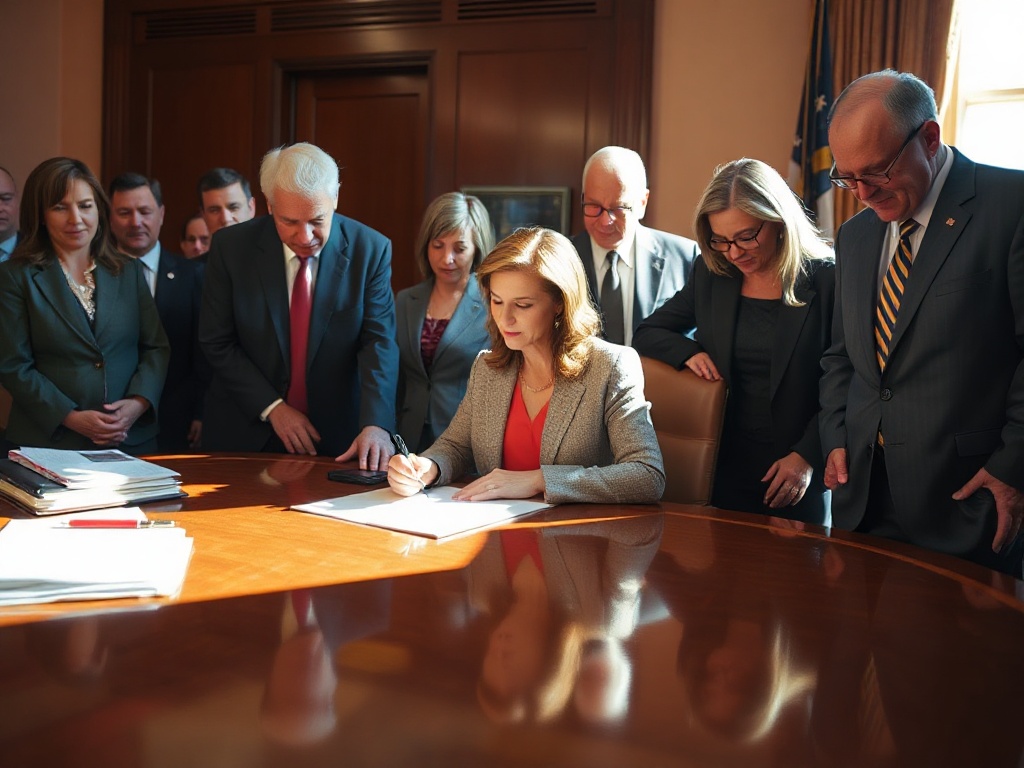
Gov. Katie Hobbs signs $18 billion Arizona budget after late-night negotiations over school funding, housing aid and border enforcement in Phoenix

Gov. Katie Hobbs signed an $18.3 billion Arizona state budget on Saturday, June 13, 2026, in Phoenix after the Legislature adjourned following late-night negotiations. The bipartisan budget, agreed upon by Hobbs and Republican legislative leaders, includes tax cuts and funding for schools, housing aid, and border enforcement, resolving months of disputes over spending priorities and tax policy, officials said.
The budget package includes approximately $1.4 billion in tax cuts phased in over several years, reflecting full conformity with federal tax reductions enacted during the Trump administration, officials said. Additional tax relief includes expanded deductions related to childcare and property tax exemptions for disabled veterans, sources confirmed. To offset new spending commitments, the budget imposes a 2.5% reduction on most state agency budgets, excluding Medicaid, corrections, the Department of Child Safety, and the Department of Economic Security, according to legislative budget documents.
Starting July 1, Arizonans will no longer pay state income tax on tips and overtime wages, and will benefit from a higher standard deduction, an expanded child tax credit, and a senior tax credit, according to Governor Hobbs’ office.
Education funding remains a contentious element of the budget. The final agreement does not renew a key funding source for K-12 public schools, drawing criticism from some Democrats and education advocates who argued for increased public school investment, according to statements from Democratic lawmakers. The controversial Empowerment Scholarship Account (ESA) voucher program remains unchanged, with no reforms or caps included, despite Governor Hobbs’ earlier proposal calling for scaled income caps and eligibility restrictions, sources said. The governor had also sought an additional $285.6 million in base funding for district and charter schools through Proposition 123, but the final budget fell short of those figures, advocacy groups and budget analysts noted.
Housing and affordability measures were included in the budget, though exact line-item amounts are less clear in public summaries. Governor Hobbs’ executive proposal had sought a $10 million annual State Low Income Housing Tax Credit to encourage affordable housing development, along with $5 million in federal ARPA funds to expand the Arizona Is Home first-time homebuyer assistance program. The proposal also included $5 million one-time from the General Fund to create a Homes for Heroes Fund aimed at reducing veteran homelessness, according to budget documents. While the final budget incorporates investments in housing and affordability, precise funding levels for these initiatives were not fully detailed in official releases, officials said.
The budget also addresses border enforcement and public safety with increased funding. Governor Hobbs’ executive proposal included a $5 million ongoing General Fund increase and a $5 million one-time allocation to support law enforcement agencies’ border security efforts, raising total state border security funding from $13.2 million to $23.2 million. It also allocated $5 million one-time for drug interdiction through the Counterdrug Task Force, $33.3 million ongoing and $1.7 million in other funds for a 5% pay raise for front-line law enforcement and correctional officers, and $1 million in ARPA funds for a statewide fentanyl awareness campaign, according to legislative budget reports. The final enacted budget was described in media coverage as making investments in public safety and border security consistent with these proposals.
A three-year moratorium on new tax incentives for data centers is part of the budget, temporarily suspending sales tax breaks and other benefits for new or expanding facilities. This moratorium is projected to save the state approximately $57 million through 2029, according to analyses reported by Axios. Existing data center projects may continue construction but will not receive new state tax incentives during the pause, sources confirmed. The moratorium and the 2.5% agency budget cuts, alongside the $1.4 billion in tax cuts, formed the central fiscal trade-offs in the bipartisan deal.
Governor Hobbs and Republican legislative leaders characterized the budget agreement as a bipartisan compromise that prevents a government shutdown while delivering tax relief and funding for key services, according to official statements. The deal was reached after months of negotiations and was passed with bipartisan support in the GOP-controlled Legislature, legislative records show. However, some Democrats and advocacy groups criticized the budget for prioritizing tax cuts and preserving ESA vouchers at the expense of stronger K-12 public school funding and social programs, as reflected in public comments and advocacy reports. Conservative critics, including the Goldwater Institute, labeled the budget approach as mismanagement, citing concerns about long-term structural issues and ESA growth.
Following the budget signing, unresolved issues remain, including the future of ESA reform, sustainable K-12 public school funding mechanisms, and whether ongoing tax cuts and agency reductions will constrain Arizona’s ability to finance housing, education, and border initiatives in coming years, analysts and political observers said. Governor Hobbs’ signing of the $18.3 billion budget concludes the 2026 legislative session, with implementation set to begin July 1.


Comments are closed.