

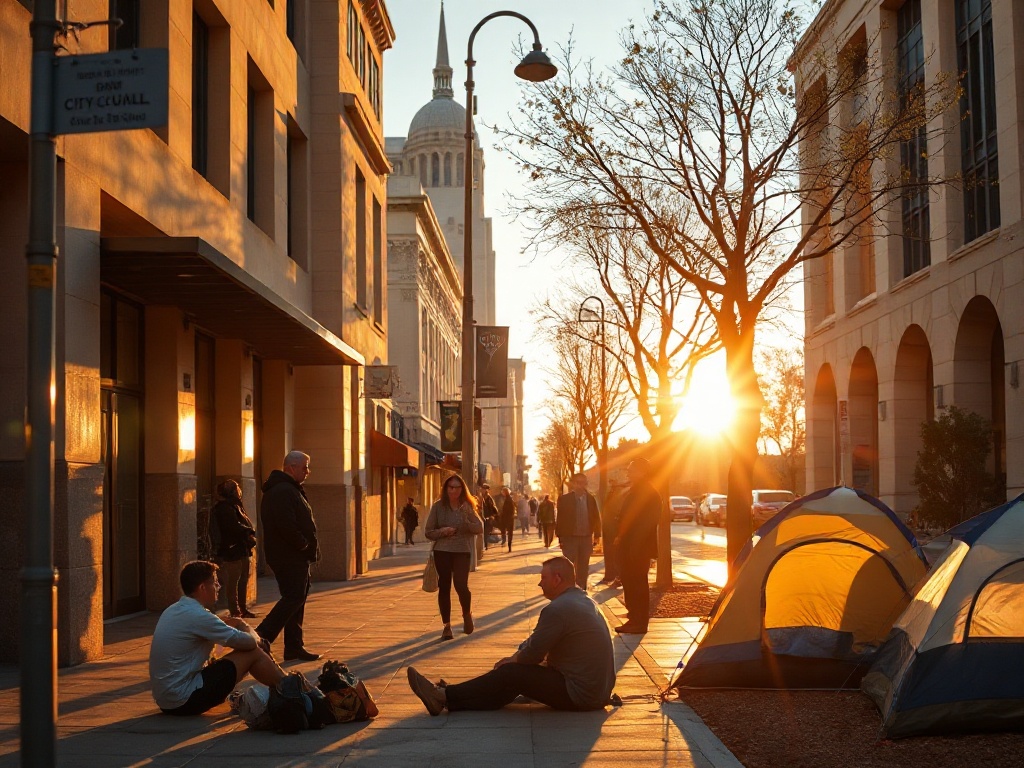
Tucson City Council advances plan to expand homeless shelter capacity and sanctioned camping areas near downtown amid rising unsheltered population in Pima County

The Tucson City Council voted Feb. 3, 2026, to declare a year-long housing and homelessness emergency to expand shelter capacity and sanctioned camping areas near downtown. Officials said the declaration allows temporary zoning flexibility and code changes, supported by $2.7 million in state funds, to address the rising unsheltered population in Pima County.
The emergency declaration approved by the Tucson City Council on Feb. 3, 2026, enables temporary zoning flexibility and code changes related to shelter care and safe-site operations, officials said. This move is intended to accelerate efforts to increase shelter capacity and other homelessness-response resources near downtown Tucson, according to city staff and council discussions. The declaration follows an earlier mayor and council declaration in October 2025 that led to new policies for temporary shelter sites, city records show.
Although homelessness in Pima County decreased by 4% year over year—the first decline since 2022—official counts showed 861 individuals in shelters with 881 available beds, Tucson Spotlight reported.
The City of Tucson announced in June 2026 that it received $2.7 million in state funding from Governor Katie Hobbs and the Arizona Department of Housing to support these efforts. City officials said the funds will be used to preserve existing emergency shelter beds and expand shelter services, including the purchase of a new hotel to stabilize Housing First and emergency shelter programs. According to the announcement, the funding aims to address ongoing challenges in accommodating the unsheltered population in Pima County.
However, the region lost approximately 200 shelter beds in transitional and permanent housing, safe havens, and related resources, which officials said adds strain to the homelessness-response system. These figures underscore the need for expanded capacity and flexibility in shelter operations, according to local officials.
City materials and announcements identify several central Tucson locations as focal points for shelter and service delivery, including Main Avenue, 6th Avenue, Park Avenue, Palo Verde Road, and Ajo Way. The city’s cooling and respite centers, such as the Donna Liggins Center, El Pueblo Center, El Rio Center, Randolph Center, and Clements Center, are concentrated in downtown-adjacent or central-city areas, according to city documents. The Housing and Community Development office, which organizes homelessness and Housing First programs, is located at 310 N. Commerce Park Loop.
In addition to shelter expansion, the Tucson City Council has addressed camping regulations in early 2026. On March 18, 2026, the council reviewed proposals affecting camping in washes, parks, and traffic medians. One proposal sought to ban camping in washes, making violations misdemeanors punishable by fines, community service, probation, or short jail terms. Another proposal aimed to redefine camping in parks to include shade structures, bedding, and stoves used as temporary living spaces. A separate measure restricted use of medians on roads with speed limits over 30 miles per hour to street crossing only. According to AzLuminaria, the council rejected the wash-camping ban but approved the median restriction; the park-camping proposal was not voted on at that time.
City staff were tasked by the council to prepare a draft declaration and implementation details within 45 days of the February vote, indicating ongoing work to operationalize the emergency declaration, sources confirmed. The temporary zoning and code changes are expected to facilitate more rapid deployment of shelter and safe-site options near downtown Tucson.
The city’s homelessness-response efforts occur amid a broader shortage of affordable housing and emergency shelter capacity in the region, according to reports by Tucson Spotlight and city officials. The emergency declaration and state funding are components of a multi-pronged approach to address these challenges, with a focus on central and south-side service corridors rather than a single shelter site.
Future council meetings are expected to continue addressing related policies and implementation measures as the city works to expand shelter capacity and manage sanctioned camping areas in response to the evolving needs of Tucson’s unsheltered population.


Comments are closed.