

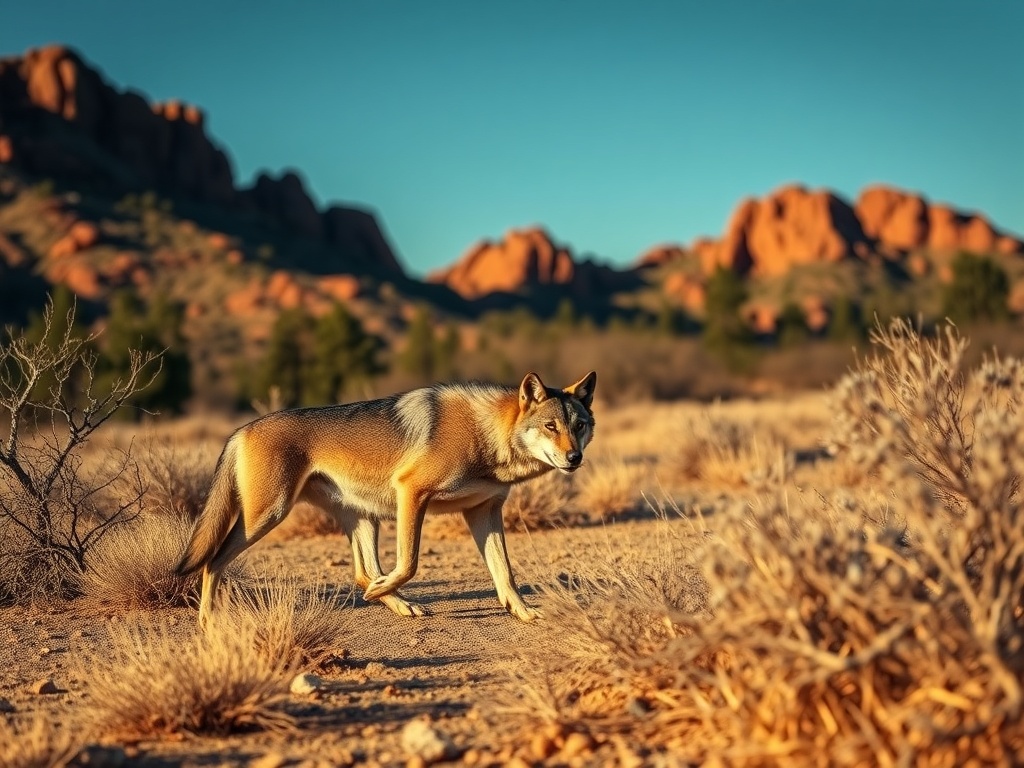

Arizona lawmakers passed HB 2787 this week, prohibiting state agencies and employees from using resources to support the Mexican wolf reintroduction program across the state. According to the bill’s text, the measure aims to assert state sovereignty and reduce spending related to the federally led effort to restore endangered Mexican gray wolves.
HB 2787, which passed the Arizona Legislature this week, prohibits state agencies, political subdivisions, and employees from using personnel or financial resources to enforce, administer, or cooperate with the federally led Mexican wolf reintroduction program. The bill amends Title 1, chapter 2, article 4 of the Arizona Revised Statutes by adding section 1-273, citing Article II, section 3 of the Arizona Constitution as the basis for asserting state sovereign authority. According to the bill’s text, the legislation authorizes no new state programs and produces no direct state expenditures; its immediate budgetary effect is to reduce or reallocate existing state spending.
Since the reintroduction began, the population of Mexican gray wolves in the U.S. has grown to 286 animals, surpassing the original recovery goal of 100 wolves set by the U.S. Fish and Wildlife Service in 2014.
The Mexican wolf reintroduction program, initiated by the U.S. Fish and Wildlife Service in 1998, involves releasing captively bred Mexican gray wolves into Arizona and New Mexico. The program expanded to Mexico in 2011, reflecting a binational effort to restore the endangered species. The Mexican gray wolf was federally protected as endangered in April 1976, shortly after the Endangered Species Act was enacted. Under the program, wolf releases were designated as purely experimental, with all Mexican wolves in the United States classified as non-essential to the species’ survival, according to official records.
Despite this numerical milestone, the species remains imperiled due to dangerously low genetic diversity, a constricted range, and a limited gene pool, conservation experts say. The population continues to face threats despite meeting the original numerical recovery objective, officials confirmed.
The projected cost to American taxpayers for maintaining the Mexican wolf reintroduction project through 2030 is estimated between $47 million and $59 million, excluding compensation funds and administrative overhead, according to budget analyses. Sponsors of HB 2787 argue these expenses are not justified because the original population goal was met and exceeded nearly a decade ago. The bill’s proponents emphasize that federal funding mechanisms currently support the program, with no direct Arizona state appropriations.
Supporters of the bill contend that the legislation addresses uncertainty for local communities regarding wolf management and seeks to protect private property rights that they say are overshadowed by ongoing federal protections for the Mexican gray wolf. U.S. Rep. Paul Gosar, R-Ariz., has introduced complementary federal legislation to remove the Mexican gray wolf from the endangered species list. The bill’s sponsors maintain that the state has the sovereign authority to limit cooperation with federal programs they consider overreaching.
Opposition to HB 2787 comes from conservation advocates who warn that removing protections would jeopardize decades of recovery work. Michael Robinson, senior conservation advocate at the Center for Biological Diversity, stated that delisting the Mexican gray wolf would cause “a massacre” of the species. Claire Musser, executive director of the Grand Canyon Wolf Recovery Project, said the bill ignores scientific evidence and disregards the fragile status of the species. Conservation groups argue that coexistence with wolves is possible when communities have access to practical, nonlethal tools and adequate support.
Federal protections under the Endangered Species Act currently provide legal safeguards that private property rights lack, according to conservation sources. Without these protections, Arizona’s existing “shoot-on-sight” laws would become applicable to Mexican wolves, potentially leading to increased killings. Similar concerns have been raised regarding New Mexico, where wolf killing would likely increase if federal protections were removed.
The Mexican gray wolf remains on the federal endangered species list despite population recovery goals being met, and the reintroduction program continues under federal oversight. The U.S. Fish and Wildlife Service’s designation of the wolf population as non-essential experimental reflects ongoing management challenges. The program’s long-term success depends on maintaining genetic diversity and mitigating threats within the species’ limited range.
HB 2787 is part of a broader slate of Republican proposals aimed at expanding predatory animal control measures in Arizona. The bill’s passage signals a shift in state policy toward limiting cooperation with federal wildlife programs. The measure now awaits consideration by the governor, who will determine whether to sign it into law.
The Mexican wolf reintroduction project remains a federally led initiative with a history dating back more than two decades. Since the first releases in 1998, efforts have focused on restoring the species to its historic range while balancing ecological and community concerns. The program’s future will depend on ongoing legislative, scientific, and management developments at both state and federal levels.


Comments are closed.