

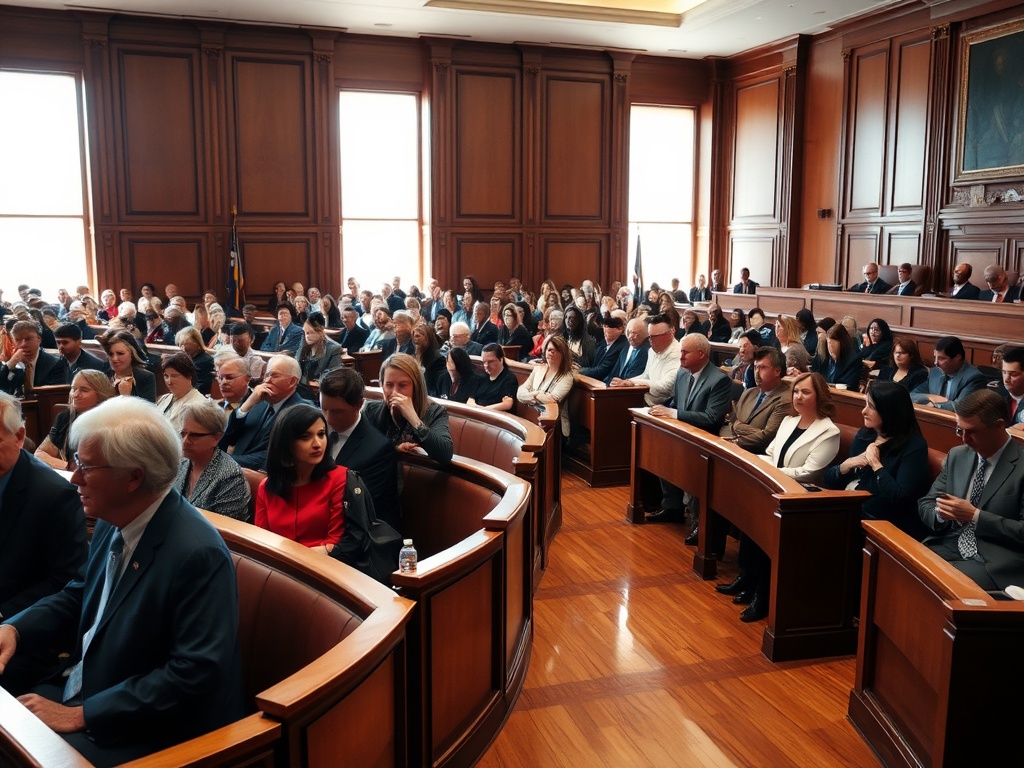
Arizona Supreme Court hears challenge to school voucher expansion, with education groups and state lawmakers packing courtroom in Phoenix

The Arizona Supreme Court heard a challenge Monday in Phoenix to the state’s expansion of school voucher programs, with education groups and lawmakers filling the courtroom. The lawsuit, filed by the Arizona School Boards Association and others, argued the expansion violates the state constitution’s prohibition on using public funds for private and religious schools, according to court documents.
The lawsuit challenges the expansion of Arizona’s Empowerment Scholarship Accounts, or ESAs, which allow parents to use state funds for private school tuition, tutoring, and other educational expenses. The Arizona School Boards Association, Arizona Education Association, and Arizona Association of School Business Officials filed the suit, arguing the expansion violates Article 9, Section 10 of the Arizona Constitution. That section, known as the “Aid Clause,” prohibits the appropriation of public money for private or religious schools, according to court documents and the complaint filed Monday.
The ESA program deposits roughly 90% of the per-pupil funding the state would otherwise allocate to public schools into accounts controlled by parents.
These funds can be used for private school tuition, tutoring, educational therapies, curriculum, and certain college expenses, officials said. While originally targeted to specific student groups such as those with disabilities or assigned to low-performing schools, recent legislation has expanded eligibility to nearly all K-12 students in Arizona, sources confirmed.
Opponents contend the universal expansion diverts significant public funds away from the state’s uniform public school system. According to advocacy analyses cited in court filings, the ESA program is projected to cost the state about $1 billion in the 2026-27 school year, with an average voucher amount exceeding $11,000 per student. This figure is higher than the base per-pupil funding for district schools, which opponents argue creates a financial incentive for families to leave public schools. Additionally, critics say approximately 75% of ESA recipients were already enrolled in private or home schooling before receiving vouchers, suggesting the program subsidizes existing private education rather than primarily serving students transitioning from public schools.
The current legal challenge follows a history of Arizona Supreme Court decisions on school voucher programs. In a landmark 2009 ruling, the court struck down two voucher programs, holding they violated the Aid Clause by using public money for private and sectarian schools. That decision emphasized the constitutional requirement to maintain a uniform public school system and remains a key precedent cited by opponents of voucher expansions. The court’s 2009 opinion also highlighted the constitutional prohibition dating back to 1910 against public funds aiding private or religious schools.
The ESA expansion at issue in Monday’s hearing builds on legislative efforts and voter actions over the past decade. In 2018, Arizona voters rejected Proposition 305, a veto referendum on Senate Bill 1431, which would have substantially broadened ESA eligibility statewide. The defeat of the measure effectively repealed that particular expansion. Before the 2018 vote, the Arizona Supreme Court ruled that voucher supporters lacked legal standing to challenge the validity of petitions placing the referendum on the ballot, thereby allowing voters to decide the issue directly.
Since the 2018 referendum, lawmakers enacted a universal ESA expansion law that permits virtually all school-age children in Arizona to apply for taxpayer-funded accounts usable for private education. A political campaign sought to refer this law to the ballot but failed to gather enough valid signatures, allowing the expansion to proceed without a statewide vote, according to state officials. This universal ESA program has been described in local coverage as a significant growth of Arizona’s private school voucher system.
Supporters of the ESA program argue it promotes parental choice and educational customization, sources close to the legislative process said. They maintain that ESAs differ from traditional vouchers because funds are deposited into parent-controlled accounts rather than directly appropriated to private schools. This distinction was a key argument in the 2011 U.S. Supreme Court case Arizona Christian School Tuition Organization v. Winn, which held taxpayers lacked standing to challenge Arizona’s tax-credit-funded scholarship program because it involved private contributions, not government appropriations.
Organized opposition to the ESA expansion includes the Arizona School Boards Association, Arizona Education Association, and Arizona Association of School Business Officials, which have jointly filed litigation against ESA laws since at least 2011. Civil liberties groups such as the ACLU of Arizona have also historically opposed voucher programs, praising the 2009 Arizona Supreme Court ruling as a constitutional safeguard.
The Arizona Supreme Court has previously ruled on procedural matters related to vouchers and referenda. In a 2018 order, the court limited voucher supporters’ ability to challenge referendum petitions, reinforcing the principle that disputes over voucher expansions can be resolved by voters rather than courts.
As the court considers the current challenge, education groups and lawmakers filling the Phoenix courtroom underscored the ongoing constitutional and fiscal debates surrounding Arizona’s expanding ESA program. The case will test the boundaries of the Aid Clause and the state’s commitment to a uniform public school system amid evolving school choice policies.


Comments are closed.