

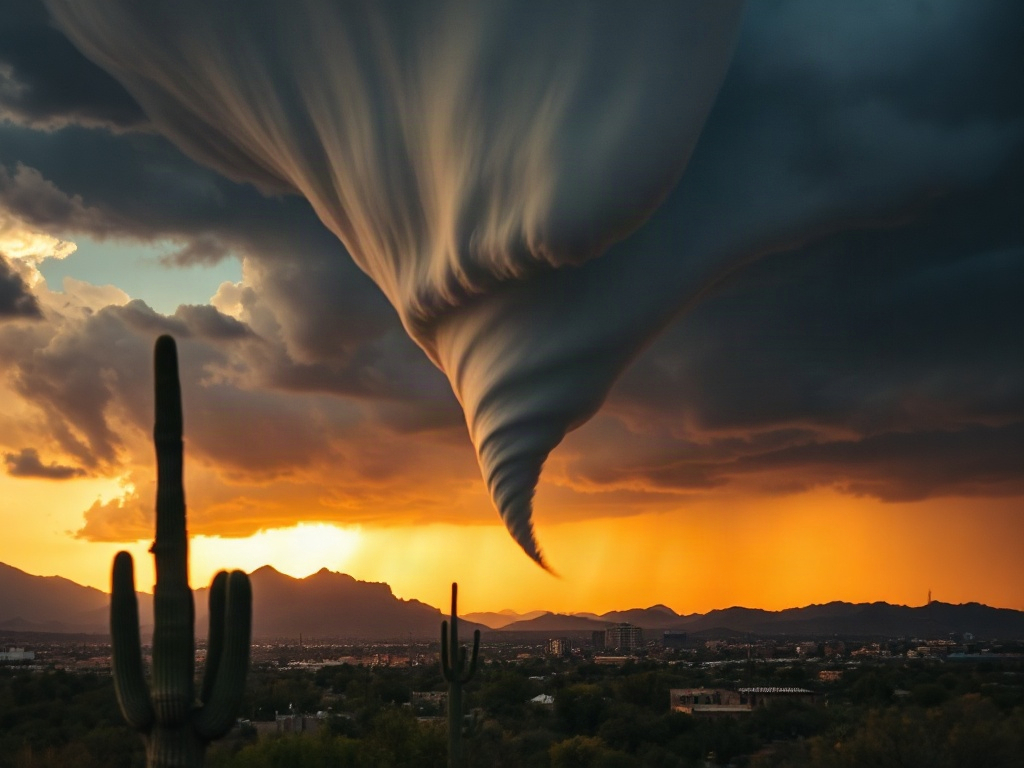

The National Weather Service in Tucson confirmed that a funnel cloud was spotted near Interstate 10 and Wilmot in Tucson on Friday, Aug. 21, 2026. Officials said the funnel cloud was associated with a non-supercell severe thunderstorm and extended about 30% of the distance from the parent cloud toward the ground.
The funnel cloud was first photographed at approximately 3:23 p.m. MST by a viewer near Interstate 10 and Wilmot Road, with the Santa Catalina Mountains visible in the background, according to KOLD 13 News. These reports were associated with a severe thunderstorm warning issued for the area on Aug. 21, 2026.
The National Weather Service in Tucson received multiple reports confirming the funnel cloud’s presence about nine miles southeast of the city, officials said.
NWS Tucson’s local storm reports classified the funnel cloud as extending roughly 30% of the distance from the parent cloud toward the ground, indicating it did not make contact with the surface. The agency described the event as occurring within a non-supercell thunderstorm, distinguishing it from tornadoes typically spawned by rotating supercell storms. No damage was reported in connection with the funnel cloud, supporting its classification as a weak, short-lived atmospheric feature.
The severe thunderstorm that produced the funnel cloud was part of a broader pattern of convective activity across Pima County during the mid to late August monsoon season. NWS storm summaries from the period documented wind gusts reaching up to 59 mph near Davis-Monthan Air Force Base, highlighting the strength of the thunderstorms affecting the Tucson area. These conditions contributed to the development of localized severe weather, including the funnel cloud event.
The August funnel cloud adds to a series of weak vortex phenomena observed in southern Arizona in 2026. Earlier in the year, on Jan. 1, the NWS reported the nation’s first tornado of 2026—a weak landspout near Three Points, southwest of Tucson. That event involved a funnel cloud briefly connecting to the ground, lasting less than a minute, and producing surface wind shear without causing damage, according to official NWS reports. Photographs from trained weather observer Eric Allan documented that landspout near Ajo Highway and Sandario Road.
The distinction between the January landspout tornado and the August funnel cloud lies in ground contact. The August event remained aloft, with the funnel extending only partway toward the ground, consistent with the NWS definition of a funnel cloud. NWS Tucson’s storm reports emphasized that the August funnel cloud formed under non-supercell conditions, which often produce weaker and less organized vortices than supercell thunderstorms.
Public involvement played a key role in documenting the August event. Multiple eyewitness reports and photographic evidence submitted to the NWS helped confirm the funnel cloud’s occurrence. The NWS Tucson office maintains active channels for receiving such observations, relying on both automated surface observing systems and trained spotters to verify severe weather phenomena. This community engagement supports accurate and timely weather reporting in the region.
The occurrence of funnel clouds and weak tornadoes during the summer monsoon season aligns with the climatological patterns of southern Arizona. While tornadoes and funnel clouds are less frequent in Tucson compared to the central United States, the 2026 events demonstrate that localized convective storms can produce short-lived vortices under favorable atmospheric conditions. NWS Tucson continues to provide Skywarn spotter training and detailed storm reports to enhance detection and understanding of these phenomena.
Records from NWS Tucson, including local storm reports and severe thunderstorm warnings, contribute to the ongoing documentation of severe weather in the region. The August funnel cloud, along with earlier events, informs statistical summaries and risk assessments for southern Arizona. These data support public awareness and preparedness efforts during the monsoon season and throughout the year.


Comments are closed.