

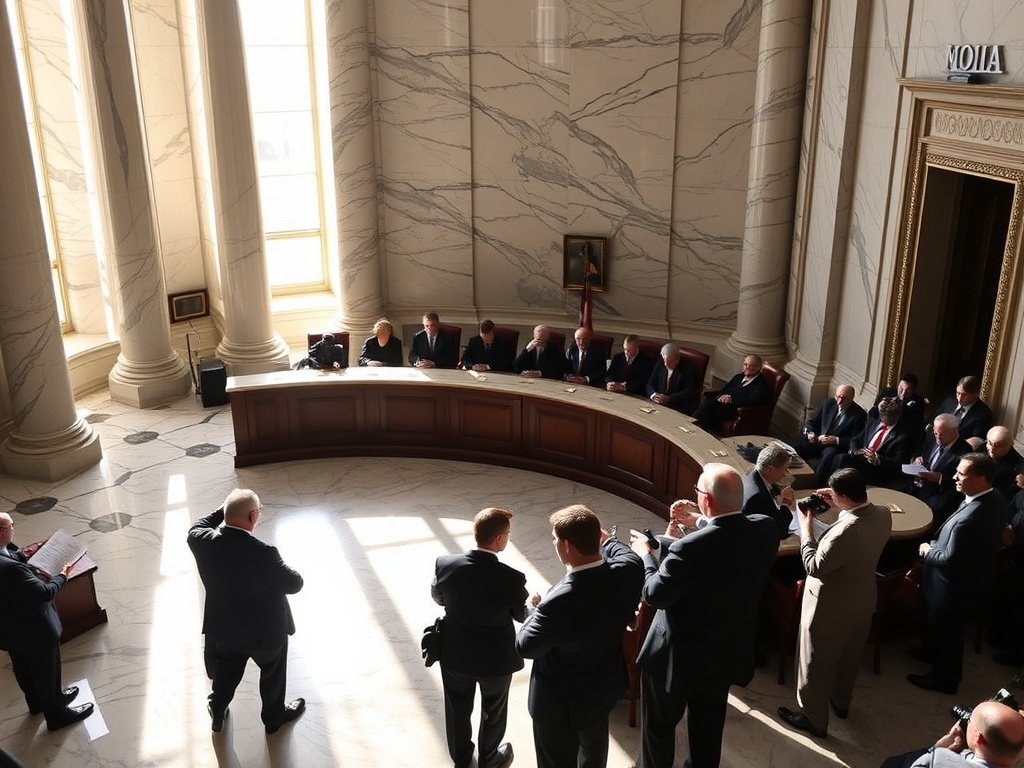

The U.S. Supreme Court agreed Monday to review Arizona’s law requiring documentary proof of citizenship for voter registration in certain elections. The justices will consider the state’s effort to tighten voting rules following the 2020 presidential election, amid Republican claims of voter fraud and previous court rulings limiting such requirements, according to court officials.
The Supreme Court’s decision to review Arizona’s proof-of-citizenship voter law centers on whether the state can require documentary proof of citizenship beyond federal law for voter registration in certain elections. The case involves a Republican-led appeal of the 2022 Arizona law, House Bill 2492, which mandates “documentary proof of citizenship” such as a birth certificate, passport, or naturalization documents for new registrants using the state voter registration form.
The law also includes provisions to purge alleged non-citizens from state voter rolls and restrict participation of registrants lacking such proof in presidential and mail-in voting, according to court records and state statutes.
Arizona’s Republican-controlled legislature passed the laws in 2022 following the 2020 presidential election, which President Joe Biden won in Arizona by 10,457 votes. The legislation was part of broader efforts by Republicans to tighten voting rules amid claims of voter fraud. However, the 9th U.S. Circuit Court of Appeals upheld a 2023 district court ruling that many provisions of the 2022 laws were unconstitutional, describing them as “unlawful measures of voter suppression” and blocking limits on presidential and mail voting for those without proof of citizenship, court documents show.
The Supreme Court’s review will address whether Arizona’s requirements conflict with the National Voter Registration Act’s (NVRA) mandate that states “accept and use” the federal mail-in registration form without demanding additional citizenship documentation. The 2013 Supreme Court ruling in *Arizona v. Inter Tribal Council of Arizona, Inc.* held that Arizona could not require documentary proof of citizenship from individuals registering with the federal form for federal elections, ruling that such requirements are preempted by the NVRA. The current appeal challenges lower-court decisions that found multiple provisions of the 2022 laws violate federal voting-registration statutes, including the NVRA, according to court filings and legal analysis.
On August 22, 2024, the Supreme Court issued a 5–4 unsigned order allowing Arizona to enforce the proof-of-citizenship requirement for new registrants using the state form, while maintaining blocks on restrictions affecting already registered voters. Justices Clarence Thomas, Samuel Alito, and Neil Gorsuch favored full enforcement of the contested provisions, while Justice Amy Coney Barrett joined the three liberal justices in opposing broader enforcement, official court records indicate.
Under the current legal framework, new registrants using Arizona’s state form must provide documentary proof of citizenship to be eligible to vote in state elections, including races for governor and the state legislature. Registrants using the federal form who do not provide such proof may vote only in federal elections, such as for president or Congress, but are excluded from state-level contests, according to Arizona statutes and court rulings. Provisions blocked by courts would have prevented voters without proof of citizenship from voting for president and from voting early by mail, even if already registered, potentially affecting tens of thousands of Arizonans, court documents show.
The law also seeks to identify and remove alleged non-citizens from voter rolls by comparing voter data against other government records, a measure critics say risks canceling registrations of eligible voters. The Arizona Attorney General’s office has issued formal opinions stating that county recorders may not deny the right to vote solely because a voter lacks documentary proof of citizenship absent specific statutory authorization, according to state legal opinions.
Election officials must follow statutory provisions such as A.R.S. § 16‑121.01(C) and A.R.S. § 16‑166(F) when determining whether new registrants have provided “satisfactory” proof of citizenship. Acceptable documents include birth certificates, passports, naturalization papers, and certain Arizona driver’s licenses. Disputes have arisen over older Motor Vehicle Division credentials issued before October 1, 1996, when stricter lawful-presence checks began. The Arizona Supreme Court ruled in September 2024 that voters with legacy driver’s licenses could fully participate in the 2024 general election despite questions about documentary proof of citizenship.
Republican state and national officials, including the Republican National Committee, have urged the Supreme Court to fully enforce the 2022 laws, arguing they are necessary to protect election integrity and prevent non-citizens from voting. In their emergency appeal and subsequent petition, Arizona Republicans framed the law as a response to alleged election fraud and asserted that federal law permits states to demand documentary proof of citizenship to safeguard state elections, according to court filings and statements from party officials.
Civil rights and voting-rights groups have characterized the laws as voter suppression, emphasizing that the 9th Circuit found key provisions to disproportionately burden eligible voters lacking ready access to documents. The groups argue that the laws violate federal protections against voter suppression and unfairly restrict voting rights, court briefs show.
The Supreme Court’s upcoming term, beginning in October, will consider whether states may impose documentary proof-of-citizenship conditions beyond federal requirements for registration and participation across different election categories. The case revisits the limits of the Court’s 2013 precedent and could clarify the balance between federal preemption under the NVRA and state authority to regulate voter registration. Legal analysts note that changes in the Court’s composition since 2013 may influence how the justices interpret these issues.
The outcome could have wider implications for other states considering similar proof-of-citizenship laws following the 2020 election. It may also affect how election officials nationwide interpret the NVRA’s “accept and use” mandate, potentially impacting millions of voters in states that tighten or relax registration documentation policies in response, according to election law experts and advocacy groups.


Comments are closed.