

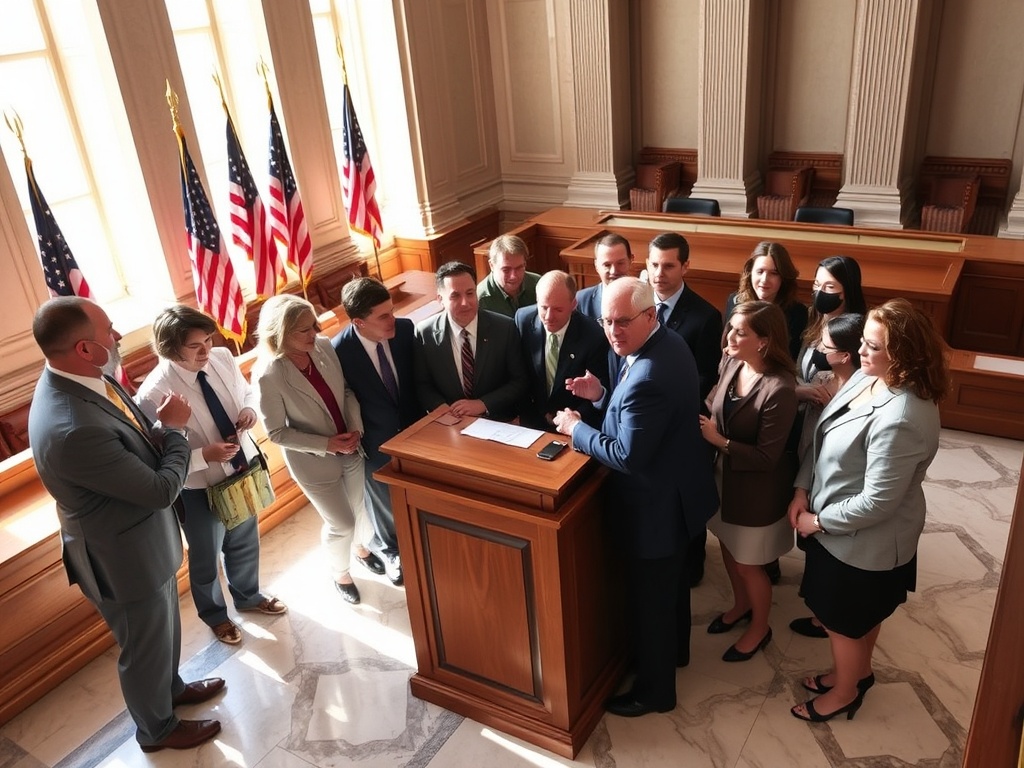

The Arizona Legislature did not pass a bill banning masked ICE agents in Maricopa County schools, according to legislative records as of February 2026. Proposed amendments to prohibit ICE agents from wearing masks during law enforcement duties were rejected along party lines, with no specific measures targeting Maricopa County schools enacted, sources confirmed.
Legislative records and multiple sources confirm that no bill banning masked Immigration and Customs Enforcement (ICE) agents in Maricopa County schools passed the Arizona Legislature as of February 2026. Efforts to restrict ICE agents from wearing masks during law enforcement duties were considered but ultimately rejected along party lines during sessions held in late February.
Rep. Sandoval introduced a House amendment to SB1635 on Feb. 26, which sought to ban masks for ICE agents, arguing that “with that authority comes the absolute responsibility to remain identifiable” and that masks “send a message of intimidation,” according to ruralazaction.org.
Two key pieces of legislation, Senate Bill 1635 (SB1635) and House Bill 2862 (HB2862), were at the center of debate. SB1635, discussed in February 2026, included proposed amendments by Rep. Mariana Sandoval and Sen. Catherine Miranda aimed at prohibiting ICE agents from concealing their identities by wearing masks while performing law enforcement activities. Sen. Miranda offered a similar Senate amendment requiring ICE agents to display identification and forbidding masks, stating the need for “transparency… No more masks. No more hiding while they kill.” Both amendments were rejected along party lines, with no Republican members supporting the measures, sources confirmed.
HB2862 also featured an amendment to ban ICE agents from wearing masks during law enforcement activities, which was voted down by House Republicans on Feb. 25-26, according to ruralazaction.org. Senate leadership reportedly declined to debate these amendments, as noted by Pablo Correa of Rural Arizona Action, who criticized the legislative leadership for blocking the measures. Correa stated, “Leadership actively chose to vote against it… Not a single Republican voted to hold ICE accountable.”
No legislative actions or amendments specifically targeted Maricopa County schools. Legislative records and official statements show no references to school-related mask bans for ICE agents. Searches found no bills, votes, or official statements linking the Arizona Legislature to restrictions on ICE agents in Maricopa County educational institutions. While protests and school walkouts opposing ICE enforcement occurred across the Arizona Valley and statewide, these actions were not connected to any mask ban legislation, according to video footage and reports.
Outside the Legislature, local governments have taken related steps. The Pima County Board of Supervisors voted 4-1 on Feb. 3, 2026, to draft an ordinance banning masks for all law enforcement personnel within the county, including ICE agents, according to azluminaria.org. This ordinance is broader in scope and not limited to ICE agents or to schools. Pima County is also drafting an ordinance to block ICE use of county properties, with a vote scheduled for March 3, 2026. However, opposition exists within local leadership; Supervisor Christy expressed concerns about potential confrontations with federal agents.
Arizona’s proposed mask ban legislation mirrored California’s earlier efforts, which included penalties of up to $10,000 for masked ICE agents, as reported by kjzz.org. The Arizona bills sought to impose similar fines and strip qualified immunity for ICE agents who conceal their identities. However, legal challenges based on the Supremacy Clause, which prevents state laws from overriding federal authority over ICE operations, complicate enforcement. The Trump administration previously sued California over its mask ban, citing an 1890 Supreme Court case, and federal court briefs have argued that masks enable plainclothes surveillance necessary to prevent evasion by undocumented individuals.
Attorney General Kris Mayes commented on the issue in a May 2026 interview, stating that Arizona’s stand-your-ground law permits the use of lethal force against unidentified masked agents, a statement that drew significant attention. Mayes’s remarks underscored the legal complexities surrounding masked federal agents operating in the state.
Public demonstrations on Feb. 26, 2026, involved residents from Cochise, Yavapai, Pima, Pinal counties, and Phoenix protesting at the state Capitol, demanding mask bans and greater accountability for ICE agents, according to ruralazaction.org. Despite this public pressure, legislative action did not follow.
SB1635 also aimed to criminalize warnings about ICE operations, but amendments related to mask bans were blocked in both the House and Senate. The failure to pass these amendments leaves Arizona without specific laws restricting masked ICE agents, particularly within Maricopa County schools.
As of early 2026, the debate over ICE agents’ use of masks in Arizona remains unresolved at the state legislative level, with local jurisdictions like Pima County pursuing their own measures. The legal and political challenges surrounding enforcement and federal-state authority continue to shape the issue.


Comments are closed.