

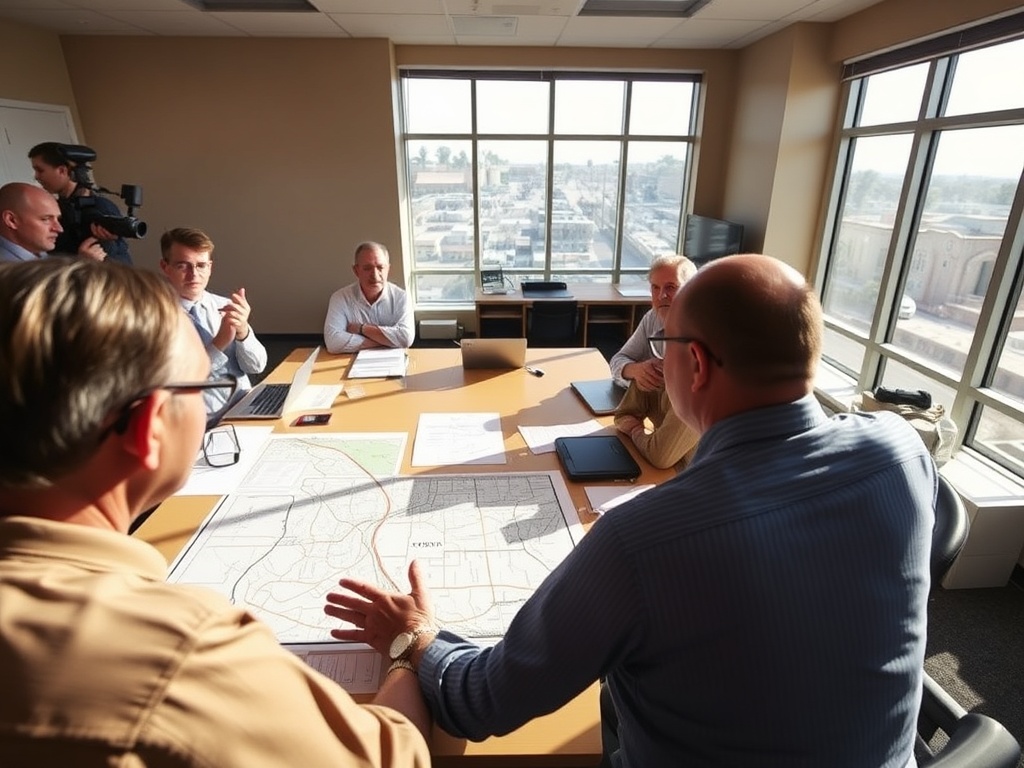
Chandler planners approve major industrial project south of Loop 202 despite traffic and water concerns

Chandler planners approved a major industrial project south of Loop 202 near Chandler Airport on Tuesday, according to city records. The development, consisting of more than 1.32 million square feet of warehouse space across 85 acres, was approved despite concerns about traffic congestion and water availability, officials said.
The Chandler Planning and Zoning Commission approved the project after reviewing a Preliminary Development Plan that laid out site design, building placement, and infrastructure provisions, according to a City of Chandler memo. The project is designed as an industrial and warehouse complex rather than traditional office space, with features such as full concrete truck courts, reinforced speed bays, 26 dock-high doors, and 301 vehicle parking stalls, according to developer Ryan Companies.
The development includes two adjacent commerce parks proposed along Ryan Road, totaling more than 1.32 million square feet of warehouse space across approximately 85.29 acres, city records show.
The site’s proximity to Loop 202 and nearby arterial roads was a key factor in the project’s planning. The development is located less than two miles from three full diamond interchanges, providing significant regional connectivity. While city officials and planners acknowledged the advantage of freeway access, traffic impacts on surrounding roadways were a central concern during the review process. Public comments and city planning documents noted potential increases in truck traffic, dock activity, and employee commuting could exacerbate congestion in the area. Despite these concerns, the commission moved forward with approval, reflecting the city’s ongoing industrial growth corridor strategy in the southeast Chandler area.
Water and utility capacity were also scrutinized as part of the approval process. The project materials submitted by Ryan Companies include plans for high-power electrical infrastructure and site utilities to support industrial operations, according to city zoning documentation. Water demand, stormwater management, and site servicing were identified as critical factors for the development’s feasibility. Officials said these infrastructure considerations are typical for large-scale industrial projects in Chandler, where utility capacity must align with the needs of warehouse and logistics facilities.
The proposed industrial campus is planned to be developed in phases, consistent with the scale and complexity of similar projects in the region. One phase includes seven to nine buildings totaling approximately 671,000 square feet, with flexibility in building count based on market demand, according to Ryan Companies descriptions. Another portion of the development involves converting a former office property into a single-story Class-A industrial building of about 87,600 square feet, supplemented by an adjacent 102,875-square-foot building. Together, these elements form a modern logistics and distribution-oriented complex designed to accommodate multiple tenants and varied industrial uses.
Ryan Companies, the named developer, has positioned the Chandler Freeways Business Park for completion by the fourth quarter of 2025, company announcements indicate. This timeline aligns with broader industrial development pressures in southeast Chandler, where demand for warehouse and logistics space has driven sustained growth along the Loop 202 corridor. Earlier planning efforts for the Ryan Road area described a multi-phase development pipeline, underscoring the city’s long-term commitment to industrial expansion in this sector.
Comparable developments near Loop 202 and Chandler Airport reflect a regional trend toward large-scale industrial campuses that leverage freeway access and modern infrastructure. City records and media reports show that the area south of Loop 202 continues to attract significant industrial investment, supported by zoning approvals and infrastructure upgrades. The latest project approval follows a pattern of phased industrial construction aimed at meeting growing market demand while addressing infrastructure and transportation challenges through city planning processes.


Comments are closed.