

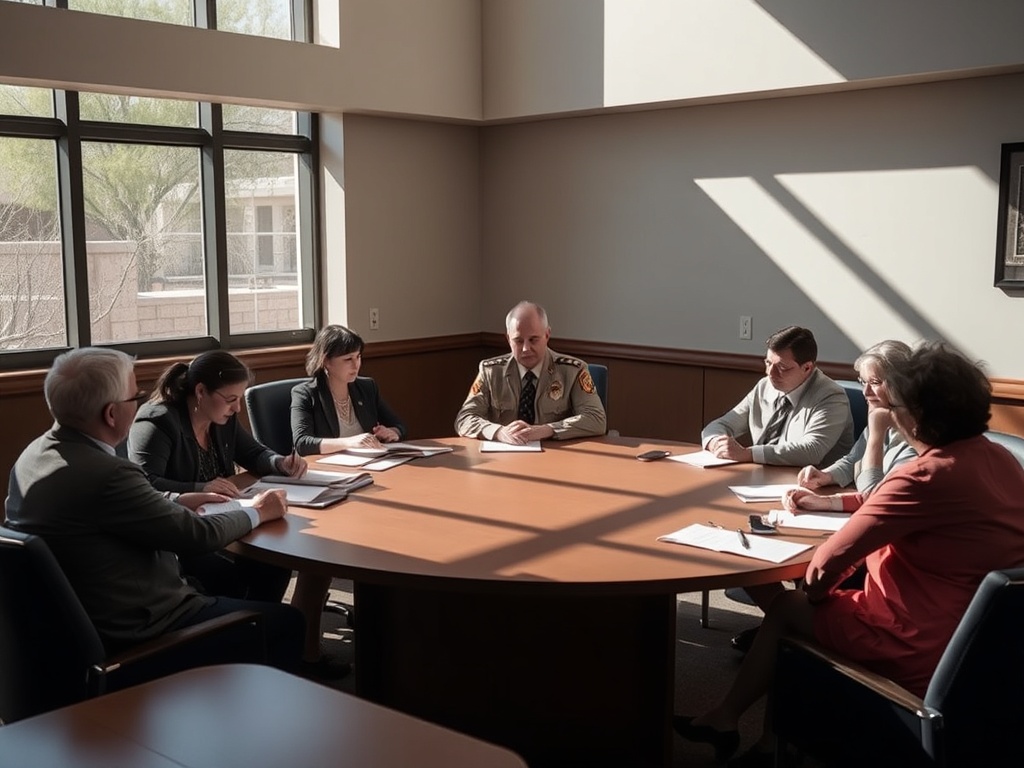

The Pima County Board of Supervisors approved a sheriff accountability plan during a March 3 meeting in Tucson. The plan aims to address eroding public trust by increasing oversight of the sheriff’s department, which receives the largest share of the county’s $1.7 billion budget, officials said.
The plan comes as the Pima County Board of Supervisors maintains primary oversight of the sheriff’s department and jail funding, with the sheriff’s office receiving the largest departmental allocation in the county’s $1.7 billion budget for fiscal year 2024-2025, according to county records. Corrections account for 32% of the sheriff’s budget, primarily covering jail operations.
The sheriff’s department budget exceeds $170 million, an increase of $11 million from the previous year, with nearly $100 million allocated to personnel costs, including deputies and correctional officers.
The board approved the sheriff accountability plan during its March 3 meeting, which coincided with the adoption of the Regional Housing Strategy and Funding Plan, a 10-year blueprint for regional housing initiatives. The housing plan includes measurable targets for production, preservation, and supportive housing outcomes, officials said.
Pima County Sheriff Mark Napier announced a three-tiered ACT reform plan emphasizing accountability, community engagement, and transparency, set to take effect in mid-August. The reform plan includes a community accountability section added to the department’s website, where major policies are posted in their entirety for public review, according to a sheriff’s department announcement made on the Wednesday prior to the board meeting.
Board Chair Adelita Grijalva expressed satisfaction that the county avoided raising the overall tax rate, which remains at $5.1048 per $100 of assessed value for the upcoming fiscal year starting July 1. The county plans to raise $575 million in taxes and an additional $254 million from service charges. Despite rising home valuations, the board has reduced the overall tax rate by 45 cents over the past five years, Grijalva noted.
Supervisor Rex Scott highlighted the board’s role in budget planning and advocacy for the more than 200,000 residents in District 1. He described the county budget as the most significant annual policy document, setting tax rates and funding priorities. Supervisor Steve Allen emphasized the county’s efforts to address root causes beyond law enforcement, citing initiatives such as the Pima Prosperity Initiative, the Sobering Alternative For Recovery Center, and expansions of the Transition Center.
The board also oversees funding and accountability for sheriff’s department operations through the county administrator’s office. Jan Lesher, the current county administrator, is set to retire at the end of 2026. The board plans to hire a new county administrator, a position that has been held by only two individuals since 1993, county officials confirmed.
On the state level, Arizona Senate Bill 1735 allocates $171,800 to the Pima County Sheriff’s Office for fiscal year 2026 to support implementation of related initiatives, according to legislative records. The bill also provides funding to nearby law enforcement agencies, including $67,000 to Oro Valley Police Department and $65,000 to Marana Police Department. The Arizona Department of Administration is required to submit a report by March 31, 2026, on the distribution of funds related to Maricopa County, which may have regional implications.
The board unanimously passes annual county budgets that set tax rates and allocate funding across departments. The FY 2024-2025 budget totals over $1.7 billion, $34 million less than the previous year, reflecting adjustments in revenue projections and spending priorities. Supervisors continue to emphasize transparency and accountability in managing the county’s largest expenditures, including those for public safety and housing.
The sheriff accountability plan and the ACT reform initiative represent ongoing efforts to increase oversight and community engagement within the sheriff’s department. The board’s approval of these measures aligns with broader county strategies to balance public safety funding with social services and housing programs aimed at addressing systemic issues in the region.


Comments are closed.