

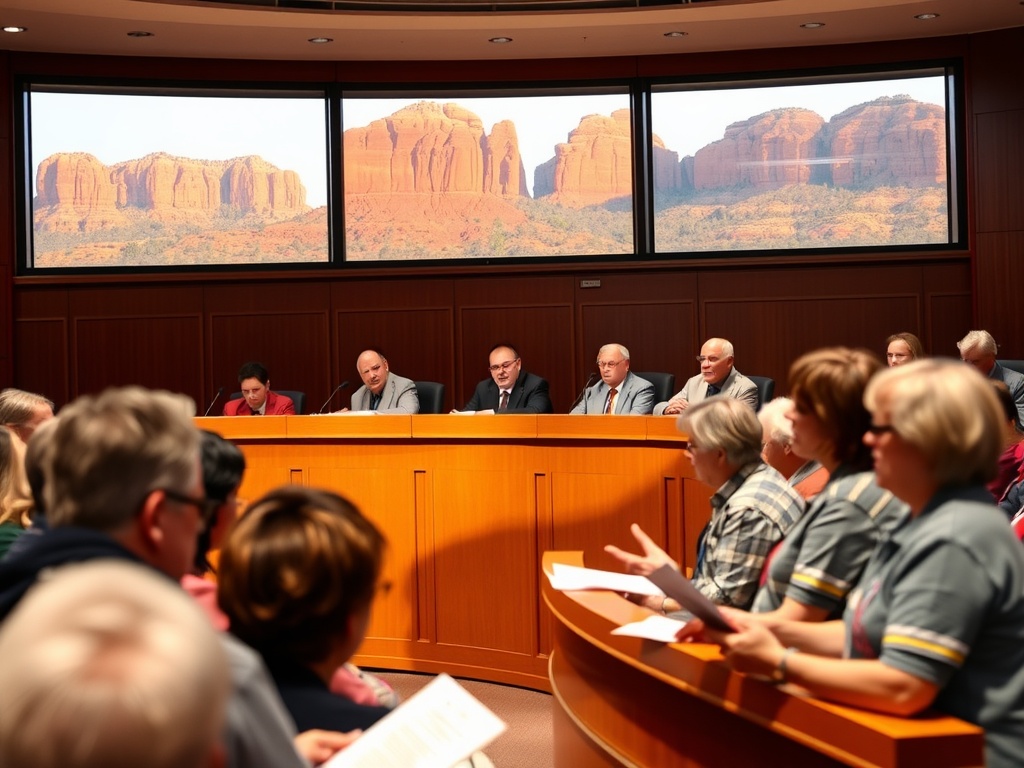
Sedona officials move to restrict short-term rentals after neighborhood complaints and tourism pressure

Sedona officials moved this week to tighten restrictions on short-term rentals within city limits. The decision came after neighborhood complaints and increased tourism pressure, with city staff citing concerns over noise, safety, and compliance with existing regulations, officials said.
Under the updated regulations, property owners in Sedona must obtain a Transaction Privilege Tax (TPT) license from the Arizona Department of Revenue and a city-issued short-term rental permit before advertising or renting their properties for short-term stays, officials said. The city’s rules, outlined in City Code Chapter 5.25, require permits for rentals of fewer than 30 days; properties rented for 30 days or more are exempt from the permit requirement, according to the city’s short-term rental FAQ.
Beginning Jan. 1, 2026, the city will impose late fees on permit renewals to improve compliance, officials said.
Sedona’s regulations apply to single-family homes, duplexes, and other approved dwelling units, but exclude apartment complexes with five or more units, recreational vehicles, travel trailers, and temporary structures such as tents or inflatable domes, city documents show. Each rental unit must have its own permit, meaning that a main house and an additional casita require separate permits. Permit renewals must be completed annually through the city’s online system, MUNIRevs, with all application information resubmitted each year.
Renewals submitted between two and 90 days late will incur a $50 fee, while those more than 90 days late will be charged $100. The late fees are one-time charges capped at $100 and must be paid along with the renewal fee.
The city maintains a 24/7 hotline at 928-203-5110 for residents to report short-term rental-related incidents, reflecting ongoing concerns about noise, safety, and neighborhood disruption. Sedona requires property owners to provide emergency contact information as part of the permitting process to facilitate rapid response to complaints, city materials state.
The tightening of short-term rental rules follows years of rising tourism and neighborhood tensions. According to a 2025 report by the Arizona Daily Star and Arizona Central, Sedona was among the first cities in Arizona to regulate short-term rentals, passing an ordinance in 2008 amid growth in the market. The city has since updated its rules and enforcement mechanisms to balance tourism revenue with resident concerns.
Market data from Airbtics indicates that as of July 4, 2025, Sedona had approximately 1,847 Airbnb listings, though none were officially licensed according to that report. The average occupancy rate was estimated at 70%, with an average daily rental rate of $272. Entire-house rentals reportedly earned up to $4,433 per month on average. City officials have not confirmed these figures but acknowledge the scale of short-term rentals contributes to neighborhood strain.
Sedona’s short-term rental regulations also prohibit special events at rental properties if those events require a special event permit or license under state law or city code. This measure aims to mitigate disruptions linked to gatherings at short-term rental homes, city documents state.
The city requires owners who do not reside full-time at their rental properties to provide an alternate mailing address for official correspondence. Owners must submit property and ownership details to the Short-term Rental Specialist via email as part of the application process, according to city guidelines.
Sedona’s regulatory framework remains constrained by state law, which prohibits municipalities from capping the number of short-term rentals operating within city limits. The city’s approach focuses on permitting, enforcement, and complaint response to manage the impact of short-term rentals on neighborhoods, officials said.


Comments are closed.