

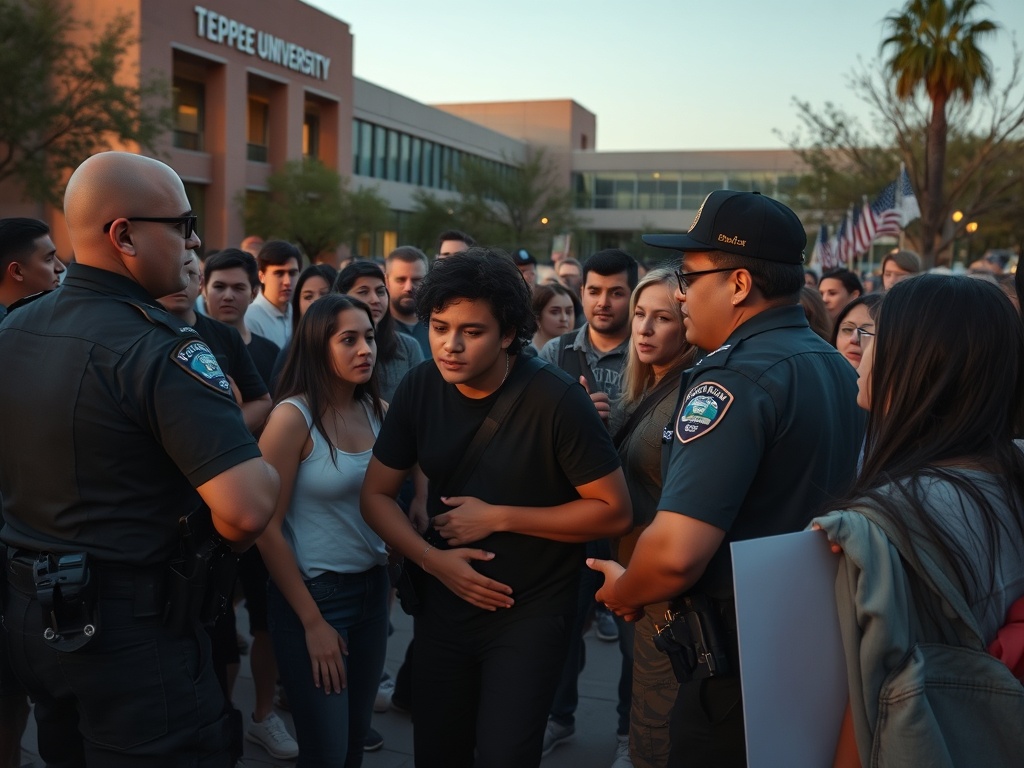

Sixty-eight demonstrators were arrested early Thursday on the Arizona State University Tempe campus after defying police orders to remove tents from the Alumni Lawn near Old Main, where encampments are prohibited, officials said. The arrests followed a large pro-Palestinian protest, with Maricopa County Attorney Rachel Mitchell stating the group violated university policy and criminal trespass laws.
The arrests occurred after demonstrators repeatedly defied orders from uniformed Arizona State University Police officers to dismantle tents and vacate the Alumni Lawn near the Old Main building, a location where encampments are explicitly prohibited under university policy, officials said. The group had maintained their presence throughout the day before officers, with assistance from the Tempe Police Department, Arizona Department of Public Safety, and Maricopa County Sheriff’s Office, took action after midnight to enforce the prohibition, sources confirmed.
Maricopa County Attorney Rachel Mitchell announced that all 68 individuals were charged with Criminal Trespass in the Third Degree, a Class Three Misdemeanor.
Mitchell emphasized that “the right to free speech does not extend to violating the law” and reiterated that “the university’s policy is clear – encampments are not permitted in this particular area on campus,” according to a statement from her office. The charges were filed following the events that took place last April, with the announcement made subsequently by the county attorney’s office in Phoenix.
Throughout the protest, ASU Police officers issued multiple requests for the demonstrators to remove their tents and leave the area, but the group continued to resist, according to police reports. The enforcement action was described as necessary to uphold campus regulations and ensure compliance with criminal trespass laws. The large pro-Palestinian demonstration had drawn attention due to the size of the encampment and the persistence of the participants despite repeated warnings.
The involvement of multiple law enforcement agencies underscored the coordinated response to the protest. ASU Police led the effort on campus, supported by officers from the Tempe Police Department, Arizona Department of Public Safety, and Maricopa County Sheriff’s Office. These agencies worked together to carry out the arrests after the demonstrators refused to comply with the university’s directives throughout the day and into the early morning hours.
University policy explicitly prohibits any form of encampment on the Alumni Lawn near Old Main, a rule enforced by campus police as part of maintaining order and safety on the grounds. Officials from ASU Division of Student Affairs have not issued a direct response regarding the protest or subsequent arrests, according to available coverage. The policy violation was cited as the basis for charging the demonstrators with misdemeanor trespassing.
The demonstration and arrests followed a timeline beginning with the establishment of tents on the Alumni Lawn earlier in the day last April. Police made repeated attempts to have the group dismantle the encampments and vacate the area, but the demonstrators’ continued defiance led to the decision to proceed with arrests after midnight. The Maricopa County Attorney’s office publicly announced the charges following the enforcement action.
No involvement by the American Civil Liberties Union or similar advocacy groups has been confirmed in connection with this case, contrasting with separate incidents reported at other universities. The legal context centers on the enforcement of campus rules and criminal trespass laws, with county officials maintaining that free speech protections do not permit violations of established policies.
The protest took place near the Old Main building on the Tempe campus of Arizona State University, a prominent location subject to specific restrictions on encampments. The coordinated law enforcement response and subsequent legal actions reflect the university’s and county’s efforts to uphold campus regulations and public safety standards.


Comments are closed.