

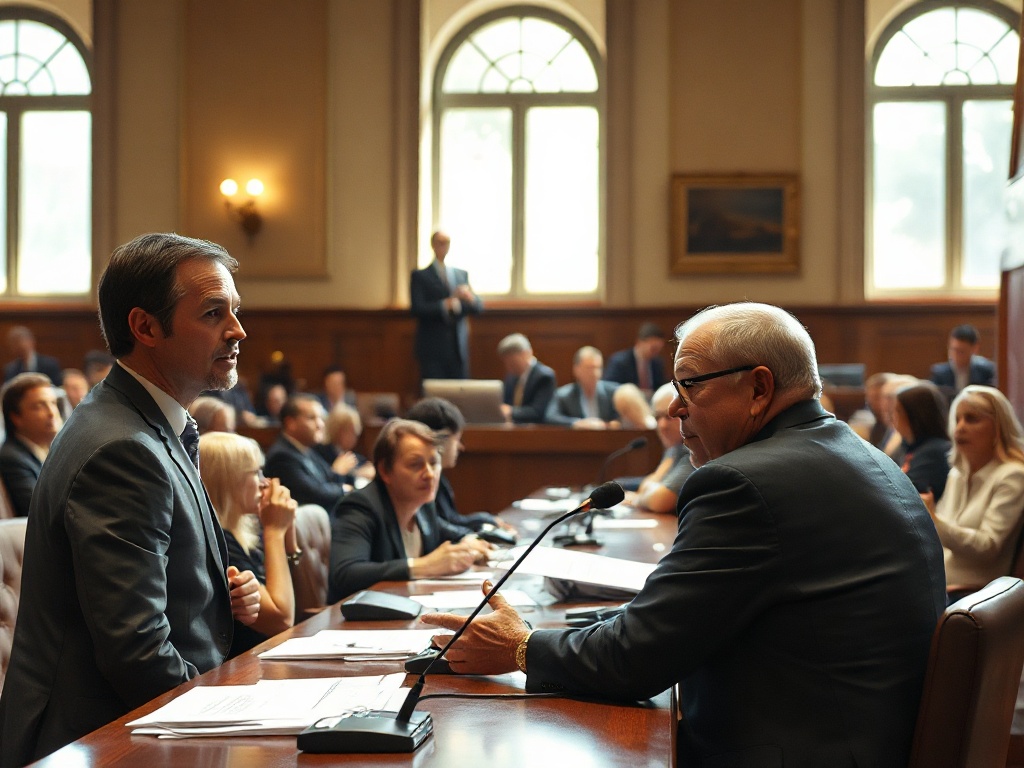
Arizona House committee at Capitol in Phoenix advances bill to restrict cities’ ability to ban gas leaf blowers, drawing protests from Tempe and Scottsdale officials

An Arizona House committee at the State Capitol in Phoenix advanced a bill Tuesday that would restrict cities’ ability to ban gas-powered leaf blowers. The measure, part of a broader Republican effort to limit local regulations on fuel-based devices, drew protests from Tempe and Scottsdale officials who oppose curbing municipal authority, according to lawmakers and city representatives.
The bill advanced Tuesday by the Arizona House committee seeks to limit or preempt the authority of cities and other public bodies to ban or heavily restrict gas-powered leaf blowers based on their fuel type, according to legislative sources and city officials. This measure is part of a broader package of Republican-sponsored climate and energy ballot proposals designed to curb local regulatory authority on environmental and emissions-related issues, records show. The Arizona House has already passed related legislation that would ask voters to amend the state constitution to block restrictions on devices based on fuel type, including gas-powered leaf blowers, according to state legislative reports.
Existing Arizona law, under A.R.S. § 49-457.01, already regulates leaf blower use in “Area A” of Maricopa County, which includes much of the Phoenix metropolitan area.
If the broader fuel-type restriction measure clears the Arizona Senate, it would go directly to the November ballot, bypassing Democratic Gov. Katie Hobbs’ veto, sources confirmed. Republicans hold a narrow one-seat majority in the Senate, making the outcome uncertain but viable if the caucus remains unified, legislative observers said.
The House committee’s bill aligns with a constitutional amendment proposal that would prohibit state or local governments from restricting devices “based on the fuel they use.” Sponsors frame the measure as protecting the right to own gas-powered leaf blowers and standardizing rules statewide to prevent what they describe as “overreach” by cities on household and landscaping equipment tied to fossil fuels, according to statements from bill proponents. The legislation targets local environmental and climate regulations, including municipal efforts to phase out noisy, higher-emission small off-road engines such as two-stroke leaf blowers.
That statute focuses on dust control and particulate emissions, requiring certain operators to receive training on proper leaf blower use to reduce PM-10 pollution, records show. The law reflects findings that gas-powered blowers emit volatile organic compounds and carbon monoxide, and that restrictions can reduce both air pollutants and neighborhood noise, according to the Arizona Department of Environmental Quality.
Local governments in Maricopa County have used both state law and local ordinances to manage air-quality nonattainment issues, including regulating off-road engines like leaf blowers as part of regional pollution control strategies, city officials said. The new House proposal would narrow cities’ discretion to go further than state law—specifically, to ban gas-powered blowers outright—by placing fuel-type usage beyond the reach of local bans, according to legislative analysis.
Officials from Tempe and Scottsdale have publicly opposed the state efforts to strip or limit cities’ authority to regulate gas-powered leaf blowers. They argue such preemption undermines their ability to address local noise and air-quality concerns, according to statements from city representatives and lawmakers. City leaders in the Phoenix metro area have historically supported or implemented stricter air-quality and dust-control rules than the statewide minimums, citing federal EPA nonattainment designations tied to particulate pollution. Municipal officials contend that local bans or tighter restrictions on gas leaf blowers are important tools in meeting regional pollution reduction targets and responding to neighborhood noise complaints, especially in dense or mixed-use areas, according to Tempe and Scottsdale environmental coordinators.
The bill’s advancement has prompted warnings from city representatives that it would lock in higher-emission equipment and delay transitions toward quieter, electric landscaping tools. This contrasts with trends in other states and localities, they said. Opposition from Tempe and Scottsdale is part of a broader pushback from local governments and environmental advocates, who view the measure as part of a larger pattern of state preemption of city-level climate policy, according to advocacy groups and municipal officials.
Gas-powered leaf blowers, particularly those with two-stroke engines, are known to emit high levels of volatile organic compounds, carbon monoxide, and fine particulates, contributing to local smog and health risks, according to environmental health studies cited by the Arizona Department of Environmental Quality. Regulatory and advocacy materials highlight that banning or tightening restrictions on such blowers can reduce neighborhood noise and air pollution simultaneously, given their characteristic high decibel levels and exhaust output.
The Arizona debate occurs alongside national and state-level moves elsewhere to phase down or ban gas-powered leaf blowers, which critics of the Arizona bill cite as contrasting policy models. For example, New Jersey’s Senate Environment and Energy Committee advanced S-217, a bill that would prohibit the sale and use of certain gas-powered leaf blowers starting with a ban on selling two-stroke gas blowers two years after the law’s effective date and banning their use four years after, according to New Jersey legislative records. The New Jersey bill also restricts four-stroke gas blowers to nonresidential areas and seasonal windows and includes civil penalties and tax credits for replacing gas blowers with electric models.
In Virginia, pending legislation would empower localities in dense urban and suburban areas to ban or regulate gas-powered leaf blowers after at least a 12-month transition period, a model opposite to Arizona’s proposed preemption, according to the Virginia General Assembly. Local jurisdictions such as Montgomery County, Maryland, have moved to restrict gas-powered leaf blowers and have rejected attempts to loosen those rules, underscoring a broader national trend toward local control and phase-outs rather than statewide protection of fossil-fuel equipment.
The leaf blower preemption bill is one of several climate- and energy-related ballot measures pursued by Arizona Republicans in the current session to work around Gov. Hobbs’ repeated vetoes of similar policy bills. Another House-passed measure would ask voters to forbid public bodies such as cities and universities from adopting climate plans, reducing greenhouse gas emissions, or encouraging reduced car travel through biking or mass transit, according to legislative summaries. These proposals collectively seek to curtail local climate action, including municipal decarbonization plans and transportation demand management. By structuring key proposals as constitutional amendments referred to the ballot, legislative leaders can bypass the governor entirely, since referred amendments do not require gubernatorial approval in Arizona, sources explained.
The single-vote GOP margin in the Senate makes each Republican member’s vote pivotal; defections could block the measures from reaching the ballot, but unified support would likely advance them to November voters, political analysts said.


Comments are closed.