

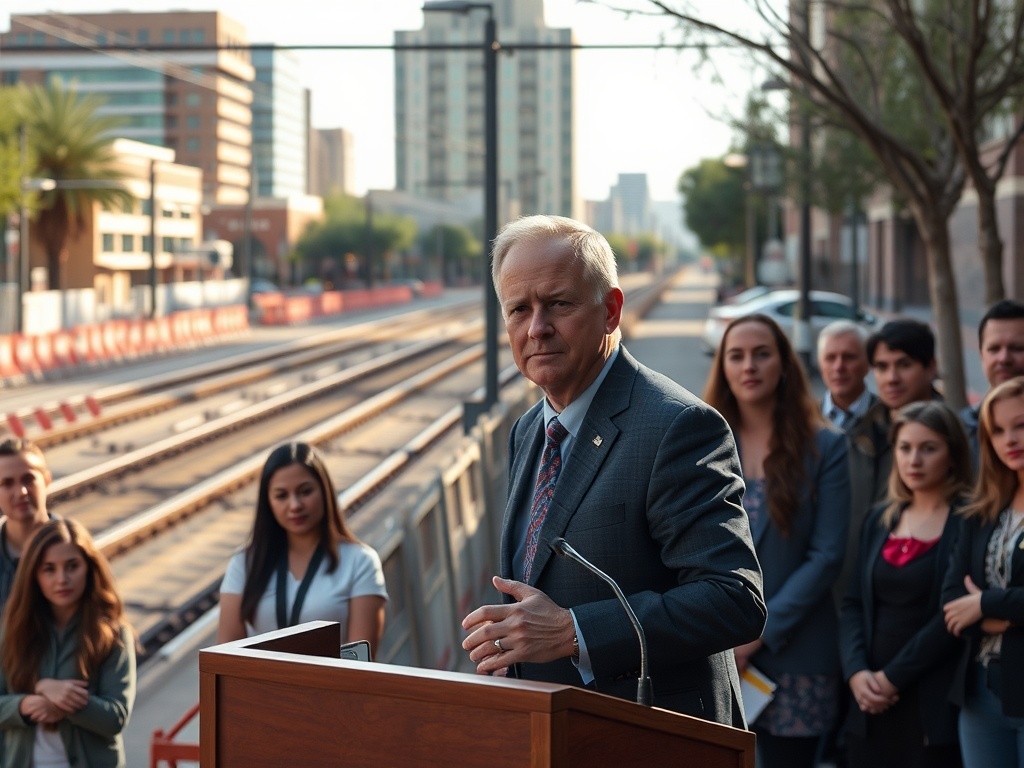

Tempe Mayor Corey Woods vetoed the city council’s approval of the controversial light rail expansion through Arizona State University’s Tempe campus on Tuesday. Officials said the decision was based on concerns about construction disruptions and potential impacts on campus safety and traffic flow.
The veto halts plans to expand the Valley Metro Tempe streetcar by more than four miles, which would have extended the existing 3-mile route eastward from its current terminus north of Mountain America Stadium along Rio Salado Parkway and south on Dobson Road to Mesa’s light rail station at Dobson Road and Main Street. The grant funding, part of the Bipartisan Infrastructure Law signed in 2021, was intended to advance the project’s engineering and environmental phases, with final recommendations expected by 2025.
The expansion, known as the Rio East-Dobson Streetcar Extension (REDE) Study, was supported by a nearly $16 million federal grant awarded in 2024 through the U.S. Department of Transportation’s RAISE program, officials said.
City officials cited concerns about construction disruptions, campus safety, and traffic flow as reasons for the mayor’s veto, according to a statement from Tempe’s city hall. The light rail expansion had drawn criticism from some community members and university stakeholders worried about the impact on Arizona State University’s Tempe campus during construction and operation. The streetcar currently serves 14 stops around the south and west borders of the ASU campus and along Mill Avenue, providing transit options for students, residents, and commuters without personal vehicles, records show.
The existing streetcar service began in May 2022 as part of Valley Metro’s broader transit network expansions, with initial construction starting the same month and completion expected in early 2024. The current route offers connections from just north of Mountain America Stadium, facilitating access to shopping, dining, and commuting within the Tempe area. The proposed expansion aimed to more than double the streetcar track length, enhancing east-west transit connectivity between Tempe and Mesa, which currently has limited public transit options in that direction, according to Valley Metro officials.
The REDE Study included community engagement efforts to gather feedback on route operations and potential impacts. Federal and state officials celebrated the $15.9 million funding at an event held at ASU in July 2024, highlighting the project’s anticipated benefits for East Valley residents and the ASU community. The extension was projected to improve access to key destinations such as Tempe Marketplace and Mesa Riverview, supporting local economic development, sources confirmed.
Funding for the initial Tempe streetcar project totaled $192 million, with contributions including $75 million from the Federal Transit Administration, $103 million from Arizona’s Proposition 400, and $13 million from a partnership involving the city, ASU, and local businesses. Related transit projects in the region include the South Central Extension, a $401 million light rail expansion set to open in 2024, partially funded by a $158 million federal Capital Investment Grant and local transportation taxes. Another significant project, the East Valley light rail extension, carries a price tag of $1.35 billion, with $637 million in federal funds, $427 million from Phoenix taxes, and $280 million from Proposition 400, according to transit records.
Valley Metro’s broader transit strategy also encompasses ongoing expansions west and south of the ASU campus, with recent approvals for mixed-use developments near new light rail stations. For example, the Dorsey Lane and Apache Boulevard station, less than a mile from the ASU Tempe campus, was approved for redevelopment in November 2025, replacing a former Food City site, officials said. Longer-term plans include potential east-west light rail connections extending to the Arizona Capitol and a line serving the I-10 West Valley corridor.
Despite the veto, Valley Metro and city officials continue to evaluate transit options to meet the growing needs of the East Valley and ASU communities. The REDE Study’s engineering and environmental assessments, funded by the federal grant, remain in progress, with stakeholders awaiting future decisions on how to proceed with expanded streetcar service between Tempe and Mesa.


Comments are closed.