

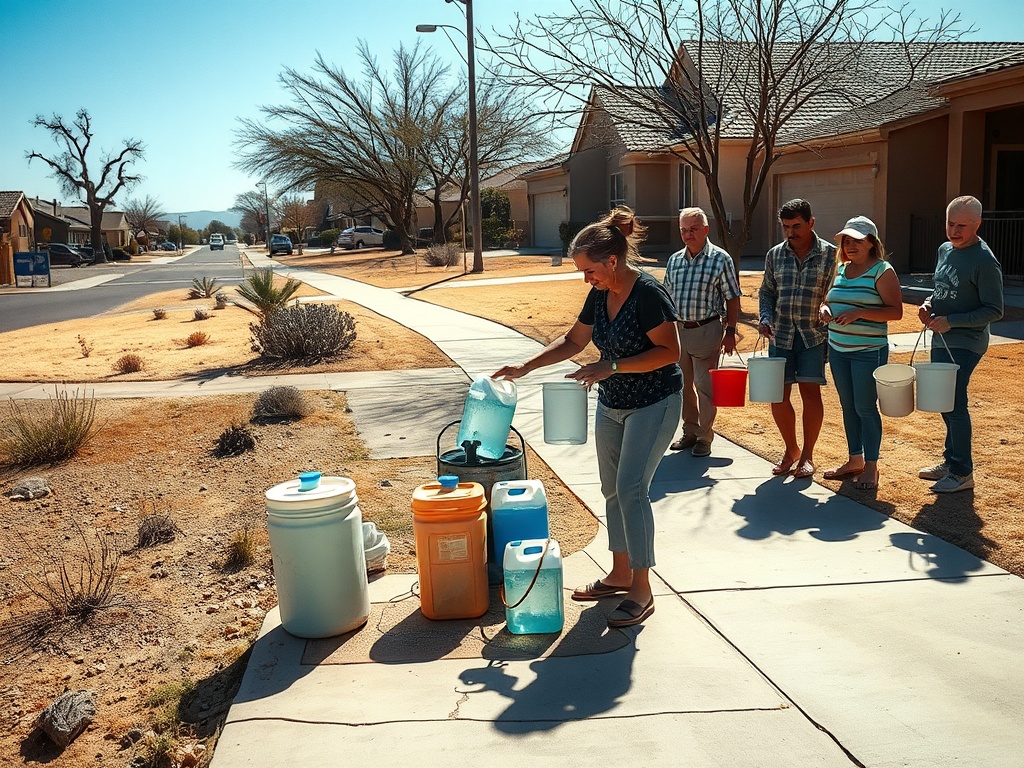

The Arizona Department of Water Resources halted new water supply certificates in June 2023 for developments relying on groundwater in Phoenix’s outer suburbs, including Buckeye. Officials said the moratorium was imposed after studies showed groundwater supplies in the Hassayampa subbasin and West Salt River Valley were critically overallocated, enforcing the state’s 1980 Groundwater Management Act requiring a 100-year water supply proof for new subdivisions.
The moratorium has had an immediate impact on development in Buckeye, where multiple projects slated for construction were halted due to unsustainable reliance on groundwater, according to the Arizona Department of Water Resources (ADWR). Local officials acknowledged shortages of millions of gallons of water for planned neighborhoods, effectively stalling the housing market overnight, records show.
The Hassayampa subbasin, which supplies Buckeye’s groundwater, was deemed severely overallocated in ADWR’s June 2023 report, forcing the complete revocation of new building permits in this rapidly growing community.
The groundwater basin in the West Salt River Valley, another critical source for Phoenix’s outer suburbs, was also identified as critically strained by ADWR. Officials said this strain prompted the agency to enforce the 1980 Arizona Groundwater Management Act, which requires proof of a 100-year water supply before issuing new water supply certificates. The moratorium followed modeling studies that concluded groundwater supplies had reached their limits, particularly affecting Buckeye and surrounding areas.
The water shortage has influenced housing markets across multiple suburbs, with reports of significant property price reductions due to groundwater deficits. Luxury estates, once valued at over a million dollars, have been sold at discounts amid rising utility bills and infrastructure costs, sources confirmed. The housing market downturn extends beyond groundwater shortages, with ADWR projecting a shortfall of nearly 8 million acre-feet of groundwater over the next century if current pumping rates continue. A video analysis cited by officials warns of a potential housing market crash in 2026 as municipal wells begin to run dry.
Compounding the crisis, the Arizona Department of Environmental Quality has flagged numerous wells for severe water quality issues, including contamination by arsenic and nitrates from fertilizers. These contaminants require costly filtration systems to meet safety standards, increasing expenses for municipalities and homeowners alike. Cities have responded by purchasing agricultural water rights, but the associated transportation costs—primarily from the Central Arizona Project (CAP) canal—are passed on to residents through higher water bills.
The CAP, authorized by Congress in 1968 with a $4 billion budget, was designed to deliver Colorado River water to Phoenix and Tucson. However, a late 1970s report by State Water Engineer Wes Steiner predicted the CAP would only cover about two-thirds of central Arizona’s groundwater overdraft. ADWR officials noted that water transported through the CAP canal requires permission and treatment before delivery, with untreated water often containing contaminants that necessitate expensive treatment.
In some communities, such as Rio Verde Foothills outside Scottsdale, the water situation has reached a critical level. Residents there rely entirely on hauled water delivered by trucks from a Scottsdale standpipe. This dependence on external water hauling has created one of the Southwest’s most severe water supply scenarios, according to local reports. The long-term reliance on hauled water has introduced significant uncertainties into the housing market, further complicating development prospects.
Utility companies serving the affected areas are implementing emergency protocols to manage water shortages and infrastructure issues. Liberty Utilities in Glendale handles low water pressure, outages, and sewer problems, advising customers to call 623-935-3395 for assistance. EPCOR Arizona operates a 24/7 outage reporting line at 1-800-383-0834 and works to restore services promptly. The Arizona Water Company uses an alert system for leaks and repairs; as of April 6, 2026, no active outages were reported.
Officials emphasized that emergencies such as burst water mains or major sewage spills require immediate attention, with residents urged to call 911 if life-sustaining medical equipment depends on water service. Registration with a physician’s letter is recommended for priority response during outages.
The ADWR’s June 2023 decision to halt new groundwater-dependent development underscores ongoing challenges in managing water resources amid rapid population growth in the Phoenix metropolitan area. The agency allowed cities to access additional water supplies in July to alleviate some pressure, but the long-term sustainability of groundwater basins remains in question. The state continues to monitor groundwater levels and water quality, with officials urging careful management to comply with the Groundwater Management Act and to secure water supplies for future growth.


Comments are closed.