


Article 5 of the North Atlantic Treaty has been invoked exactly once in 77 years. It took 21 days to formally confirm, and over two months before Germany committed troops. The trigger was the most unambiguous attack imaginable — passenger jets flown into buildings on live television. Now imagine the trigger is a jammed GPS signal. Or a severed undersea cable. Or a few hundred migrants pushed across a border at gunpoint. This is the challenge facing NATO along the Suwalki Gap, the 65-kilometer corridor where Russia is testing the Alliance every single day.
A 65-Kilometer Lifeline Through Forest and Marsh
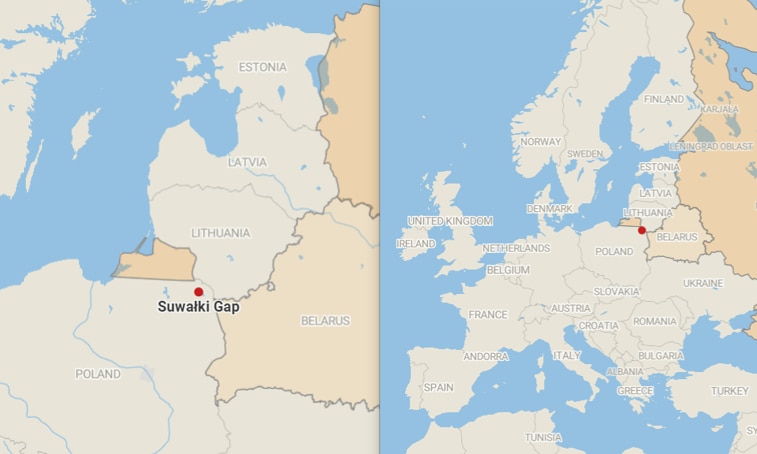
NATO’s entire overland connection to three member states runs through a single corridor barely 65 kilometers wide at its narrowest. The Suwalki Gap — named for the Polish town at its center — stretches along the border between northeastern Poland and southern Lithuania, flanked on the west by Russia’s Kaliningrad exclave and on the east by Belarus. Six million people in Estonia, Latvia, and Lithuania depend on this corridor for land-based reinforcement and supply.
The landscape offers little comfort to military planners. The Augustów Primeval Forest and Biebrza National Park marshlands cover roughly half the terrain, restricting heavy armor to a handful of routes. Just two major roads and one rail line thread through the gap. The Via Baltica highway — European Route E67 — is the primary artery, though key segments linking Suwałki to Lithuania’s A5 highway were inaugurated only in October 2025, with full expressway completion pushed to 2030. The corridor’s importance extends beyond the military: it carries the GIPL gas interconnector, opened in May 2022 as the sole terrestrial pipeline linking Baltic and Finnish gas networks to the wider European grid.
The geometry of a potential Russian attack is brutally simple. Forces pushing west from Kaliningrad and east from Belarus’s Grodno region — where installations sit 25 kilometers from the Polish border and a single kilometer from Lithuania — would need to link up across just 65 kilometers of allied territory to create a land bridge between Kaliningrad and Belarus. The three Baltic states would be severed from overland resupply, accessible only by sea or air through the anti-access/area denial zone that Kaliningrad’s S-400 batteries and Iskander-M missiles create.
Former Estonian President Toomas Hendrik Ilves first introduced the concept to NATO’s strategic vocabulary around 2015. U.S. General Ben Hodges, then commanding American ground forces in Europe, described the Gap as “one of the most volatile points on the world map.” RAND Corporation’s 2016 wargames — which found Russian forces could reach Tallinn and Riga in 36 to 60 hours — cemented the Suwalki Gap as the Alliance’s defining vulnerability.
Putin’s Hybrid Warfare Machine Is Already Running
Five fronts, one strategic objective. Russia’s campaign against the Suwalki corridor combines electronic warfare, weaponized migration, infrastructure sabotage, maritime interference, and military intimidation — each calibrated to inflict maximum damage while staying below whatever threshold might trigger NATO’s collective defense.
GPS jamming leads the assault. Poland recorded nearly 2,800 cases of GNSS interference in January 2025 — a sharp rise from roughly 1,900 incidents in late 2023. Lithuania logged over 1,185 cases that same month, more than doubling its March 2024 count. Latvia went from 26 incidents across all of 2022 to 820 in 2024. Sweden’s cases surged from 55 in 2023 to over 730 by late August 2025. The EU has described the pattern as “a systemic, deliberate action by Russia and Belarus.”
Researchers pinpointed the sources. Scientists from Gdynia Maritime University, the University of Colorado, and Poland’s Maritime Office used Time Difference of Arrival sensors to trace the jamming to two locations in Kaliningrad — the Okunevo antenna site and the Baltiysk military area, home to Russia’s Baltic Fleet — with roughly one-kilometer precision. Moscow effectively confirmed responsibility in June 2025, stating that jamming would continue for military reasons. The disruption spans all four satellite constellations — GPS, GLONASS, Galileo, and BeiDou. An RAF aircraft carrying UK Defence Secretary Grant Shapps was jammed near Kaliningrad in March 2024; two Finnair flights to Tartu turned back in April 2024; and a plane carrying European Commission President von der Leyen lost GPS signal near Plovdiv, Bulgaria in August 2025, forcing pilots to resort to paper charts. The European Aviation Safety Agency documented an 80% increase in GPS outage events from 2021 to 2024, with spoofing attacks surging 500% in 2024 alone.
In January 2026, fourteen European coastal nations issued a joint open letter warning that Russian GNSS interference was endangering all maritime traffic in the Baltic, and called for alternative terrestrial radionavigation systems — tacitly conceding that Russia had compromised a foundational element of global navigation safety across an entire sea.
The weaponized migration front has been the deadliest. Since 2021, when Belarusian dictator Alexander Lukashenko vowed to “flood Europe with drugs and migrants,” Minsk has funneled Middle Eastern and African migrants toward the Polish, Lithuanian, and Latvian borders. Belarusian guards have been documented tearing down Poland’s border fence and using lasers and strobe lights to blind Polish patrol officers. At least 87 people have died near the Polish-Belarusian border since September 2021. In May 2024, Polish soldier Mateusz Sitek was fatally stabbed through a border barrier — the first NATO soldier killed as a direct result of the migration weapon. In January 2026, Latvia formally confirmed Belarusian military involvement in directing migrants toward its border. Polish Prime Minister Donald Tusk stated: “It is the Russian state that is behind the organization of the recruitment, transport and attempts to smuggle thousands of people into Europe.”
Undersea infrastructure sabotage constitutes a third front. At least eleven incidents have struck Baltic cables and pipelines since 2022. The Balticconnector gas pipeline was severed in October 2023 by a Chinese-flagged vessel dragging its anchor at 11 knots. Two cables — the BCS East-West Interlink and C-Lion1 — were cut within 24 hours in November 2024; German Defense Minister Pistorius said no one believed the damage was accidental. On Christmas Day 2024, the shadow fleet tanker Eagle S dragged its anchor nearly 100 kilometers, severing the Estlink 2 power cable and four telecom cables; Finnish authorities charged crew members with sabotage.
Most disturbingly, the Organized Crime and Corruption Reporting Project revealed in March 2026 that Russia’s shadow fleet tankers now carry military and intelligence personnel. Crew manifests for the tanker Kira K listed GRU-linked personnel and Wagner Group veterans as “supernumeraries.” A former CIA officer told OCCRP: “Nowhere else in the world have there been as many cable cuts, and in a short time, as there have been in the past two years in the Baltic Sea.”
“Not random incidents but a systemic, deliberate action by Russia and Belarus.” — EU document on GNSS interference
The Treaty’s Most Dangerous Three Words
Article 5 of the North Atlantic Treaty states that the parties agree “an armed attack against one or more of them” shall be considered an attack against all. The critical phrase — “armed attack” — is deliberately undefined. Article 6 defines the geographic scope but says nothing about cyberspace, information warfare, or hybrid operations. Each member decides individually what action to take in response, and the phrase “such action as it deems necessary” means there is no automatic military obligation.
Invocation requires consensus — unanimity among all 32 members of the North Atlantic Council. The only precedent is September 11, 2001. The preliminary invocation came less than 24 hours after the attacks, but formal confirmation took 21 days. Germany’s Bundestag did not vote to commit troops until November 16 — over two months later. In a hybrid scenario, where attribution is ambiguous by design, the timeline would almost certainly be longer. The Belfer Center warned that consensus “can take days or even weeks,” and that “the time required to reach consensus risks giving aggressors a window to escalate attacks.”
The blocking risk is not theoretical. In February 2003, France, Germany, and Belgium blocked Turkey’s request for NATO defense preparations against Iraq, paralyzing the Alliance for weeks. Today, Hungary under Viktor Orbán maintains close relations with Moscow, has blocked or delayed multiple NATO decisions, and sent observers to Russia’s Zapad-2025 exercises. Turkey has independent strategic interests and a history of blocking NATO action. The Die Welt wargame demonstrated that even Germany — the framework nation for Lithuania’s defense — might default to diplomacy rather than force in the critical first 72 hours.
This is precisely the seam Russia’s gray zone doctrine is designed to exploit. The concept, described in academic literature as “salami tactics,” involves incremental provocations calibrated to stay below whatever threshold might trigger collective response. Each individual act — a jammed GPS signal, a dragged anchor, a few hundred migrants pushed across a frozen border — is deniable, ambiguous, and insufficient to justify invoking the most consequential mutual defense clause in history. Cumulatively, they degrade Alliance infrastructure, test response mechanisms, map decision-making patterns, and condition NATO publics to accept interference as a new normal. The Center for European Policy Analysis warned in 2026 that “if an adversary deliberately cut off all energy cables to a NATO member, would that be recognized as an act of aggression? Without a clear stance, adversaries may exploit uncertainty.”
The Wargame That Exposed NATO’s Paralysis
The most alarming finding of early 2026 did not come from a satellite image or a battlefield report. It came from a conference room in Hamburg, where a group of sixteen former NATO officials and defense experts sat down to simulate a Russian attack on the Suwalki Gap — and discovered that the Alliance could not respond.
Organized by Die Welt newspaper and the Helmut Schmidt University Wargaming Center, the exercise was set in October 2026, following a hypothetical failed Ukraine ceasefire. Alexander Gabuev of the Carnegie Russia Eurasia Center played Putin; Franz-Stefan Gady, an Austrian military analyst, played Russia’s chief of general staff. Russia executed a multi-vector strategy: offering Germany discounted gas, massing forces in Kaliningrad and Belarus, fabricating a humanitarian crisis around Lithuanian transit restrictions, and deploying drones to mine the border. The result: Russian forces captured Marijampolė — the critical road junction linking Poland to the Baltic states — in three days. Germany’s simulated government chose sanctions and consultations over military force. Article 5 was never invoked. Just 15,000 troops had paralyzed NATO.
Separately, the Belfer Center at Harvard published “Russian Threats to NATO’s Eastern Flank” on February 5, 2026. The report modeled a likely gray zone scenario — a covert incursion into Narva, Estonia, using unmarked forces and drones under Kaliningrad’s S-400 and Iskander cover — and concluded that a fast-moving operation could present NATO with a fait accompli before the Alliance achieves political consensus. A less probable but more dangerous second scenario involved a mechanized two-pronged drive through the Suwalki Gap from Kaliningrad and Belarus. The Belfer team assessed Russia could rebuild limited incursion capability within two to three years of a Ukraine ceasefire; full offensive capability in seven to ten.
“We discovered that their reaction would not be adequate to defend the North Atlantic Alliance,” Gabuev said. Gady put it more directly: “Russia’s military objective in the Baltic states would be to discredit NATO as an alliance. This can be achieved by convincingly demonstrating that NATO and the rest of Europe would be largely powerless.”
NATO Is Reinforcing, but the Political Gap Remains
The Alliance’s military investments since 2022 have been substantial. At the Hague Summit in June 2025, allies committed to 5% of GDP in defense and security spending by 2035 — a dramatic increase from the 2% target most members had not yet met. The split: 3.5% for core military capability, 1.5% for cyber defense, infrastructure resilience, and civil preparedness.
On the ground, the changes are visible. Germany’s 45th Panzer Brigade “Litauen” — the first permanent German brigade deployed abroad since 1945 — began operations at Rūdninkai in May 2025, fielding 5,000 personnel and Leopard 2A7 tanks 30 kilometers from Belarus. Lithuania plans to locally assemble 41 Leopard 2A8 tanks by 2030 and has invested over one billion euros in supporting infrastructure. Poland’s commitment is even larger: 4.7% of GDP on defense, a military that has grown from 89,000 to 216,000 troops, and the $2.5 billion East Shield program — 700 kilometers of fortifications, surveillance systems, counter-drone technology, and intelligent minefields along the Kaliningrad and Belarusian borders. The U.S.-led enhanced Forward Presence battlegroup at Bemowo Piskie, directly beside the Suwalki Gap, integrates M1A2 Abrams tanks and Bradleys with British, Romanian, Croatian, and Polish forces.
In the maritime domain, NATO launched Baltic Sentry in January 2025 and Task Force X Baltic five months later, combining over 60 autonomous platforms with AI-driven analysis to monitor Baltic vessel traffic. Canada’s battlegroup in Latvia exceeded 3,500 troops after reaching full brigade status in July 2024. Finland’s Multi-Corps Land Component Command in Mikkeli became operational in September 2025.
These military deployments, however, have not been matched by political clarity on hybrid warfare. The Hague Summit stated that hybrid threats “could potentially invoke collective defense responses if attacks result in severe consequences” — wording the European Policy Centre called inadequate, noting its near-identity to the 2016 Warsaw declaration. No hybrid attack threshold was defined. No trigger mechanism was established. No response timeline was mandated. The primary focus was securing President Trump’s commitment to Article 5, which he conditioned on spending targets.
What Putin Actually Wants
Western think tanks broadly agree: Putin’s objective in the Baltic is not seizing territory but fracturing NATO. The Suwalki Gap is valuable to Moscow precisely because the threat of its closure exposes the Alliance’s deepest structural problems — consensus paralysis, attribution ambiguity, force-to-space imbalance, and the perennial question of transatlantic commitment.
Kaliningrad’s military posture serves both deterrence and coercion. The 152nd Guards Missile Brigade fields nuclear-capable Iskander-M missiles with ranges exceeding 500 kilometers — enough to reach Warsaw and Berlin. During Zapad-2025, OSINT group CyberBoroshno geolocated Iskander launchers pointed at Poland. Four S-400 battalions project an anti-access bubble across Lithuanian and Polish airspace. Bastion-P coastal missiles and Krasukha-4 electronic warfare systems complete what analysts call Europe’s most layered A2/AD complex. Ground forces were weakened by Ukraine deployments — the 11th Army Corps took heavy losses near Kharkiv — but air, naval, and missile assets remain intact. Putin warned in December 2025 that a Kaliningrad blockade would cause “unprecedented escalation” and that Baltic beaches might become “slightly radioactive.”
Not all analysts agree the Suwalki Gap is the central flashpoint. Chatham House’s Alexander Lanoszka argues Russia has no rational incentive to close the corridor given functioning transit agreements through Lithuania. Michael Kofman has called it a “MacGuffin.” The Belfer Center itself considers a full seizure less likely than a gray zone incursion.
CNAS raised the most sobering scenario: a simultaneous U.S.-China crisis in the Indo-Pacific that draws American intelligence and logistics assets away from Europe. Under those conditions, Russian hybrid operations along the Baltic could go undetected and unanswered. Putin’s calculation, CNAS assessed, would be that Washington cannot sustain commitments on both sides of the globe at once.
The Corridor in April 2026
The Suwalki Gap is quiet in the way that a building is quiet between earthquakes. No conventional military engagement has occurred. NATO controls the corridor. But every day brings fresh GPS jamming, and the Baltic Sea’s undersea cables are now severed with near-monthly frequency. Intelligence operatives sail through NATO waters on shadow fleet tankers. And when sixteen experienced defense officials simulated a Russian attack on the corridor, the Alliance never mobilized.
After the wargame, NATO Secretary General Mark Rutte insisted on the Alliance’s readiness. The Baltic states rejected the exercise as “insulting.” Neither response engaged the core finding: political will, not military capability, was what failed. Fifteen thousand Russian troops broke NATO’s decision-making process without ever engaging NATO’s forces.
The Ankara Summit on July 7–8, 2026, will review the 5% spending commitment and “non-traditional threats” including cyber and infrastructure defense. The question it must confront is one the Hague Summit avoided: when does the accumulated weight of hybrid warfare — GPS jamming, cable sabotage, weaponized migration, maritime intimidation — cross the threshold of “armed attack” and trigger the collective response Article 5 promises?
Conclusion
The Suwalki Gap is not a future crisis. It is a present one, deliberately maintained at a temperature just below the boiling point by a Kremlin that has studied NATO’s decision-making architecture and concluded — with evidence from wargames, summit declarations, and allied behavior — that the Alliance will not act collectively against threats it cannot unanimously classify as an armed attack. Putin’s gray zone campaign is not a prelude to conventional war. It is a substitute for it — a means of achieving strategic objectives, degrading Alliance cohesion, and demonstrating NATO’s impotence without ever crossing the line that triggers the response Moscow cannot survive.
The fourteen nations that signed the January 2026 maritime warning understood this. The researchers who pinpointed jamming signals to specific buildings in Kaliningrad understand this. The analysts at the Belfer Center and Carnegie and RAND understand this. The question is whether thirty-two allied governments, each with a veto, each with its own calculus, each watching its own domestic politics, can understand it quickly enough — and act on it decisively enough — to close the gap between what Article 5 promises and what NATO actually delivers. The corridor is 65 kilometers wide. The distance between deterrence and disaster may be considerably narrower.


Related Coverage:
→ Read this investigation on Peach State Press
→ See coverage from North Carolina Chronicle

Comments are closed.